
Inflammation Is Driving Your Chronic Pain. Here Are Sixteen Ways It Does It That Nobody Explained To You.


TL;DR
Chronic pain is rarely a story of damaged tissue that refuses to heal. More often it is a story of inflammation that was never given the signal to stop, and that has since changed your nerves, your spinal cord, your brain chemistry, your hormones, your gut, your blood vessels, and the energy supply inside your cells. This article walks through sixteen specific mechanisms, including the active cleanup process your body must switch on to end inflammation (which common anti-inflammatory drugs can interfere with), the way inflammatory chemicals recalibrate your pain sensors until a shirt hurts, the way inflammation can turn the spinal cord's brake pedal into a gas pedal, and the reason you can have high cortisol and high inflammation at the same time. It explains why a single medication aimed at a single mechanism rarely resolves chronic pain, and what the upstream approaches look like.
What Most Patients Are Told
If you have lived with chronic pain for a long time, you have probably heard some version of the same explanation. Your scans look fine, or they show something modest that does not seem to match how much you hurt. Inflammation is named as the culprit, and you are given an anti-inflammatory, a steroid, a nerve medication, or an antidepressant, sometimes several, and told to manage your stress and your sleep. When none of it fully works, the conversation tends to drift toward the idea that you are more sensitive than most people, or that part of the pain is in your head.
You are not imagining it, and you are not oversensitive. The explanation you received was real as far as it went, but it stopped well short of what inflammation does to a body when it persists. What follows is the rest of that explanation.
Where The Conventional Explanation Breaks Down
Inflammation is not the villain by nature. After an injury, acute inflammation is appropriate and necessary, and the swelling, heat, and pain are part of a healing process that has a beginning and an end. Chronic inflammation is a different thing. It stops being a response to an injury and becomes a self-sustaining state that changes the tissue and the nervous system it touches.
Conventional treatment tends to treat inflammation as a single dial to turn down, using a drug aimed at one enzyme, one receptor, or one signal. Each of those medications has a sound mechanism and helps many people, and nothing in this article is a reason to stop one that is helping you. The limitation is structural. Chronic inflammation is not one dial. It is a flame that moves through many rooms of the body at once, and a drug aimed at one room leaves the flame burning in the others without asking what keeps it lit. The sixteen mechanisms below are the rooms, and as you read, notice how often they feed each other.
Your Body Ends Inflammation On Purpose, Not By Running Out Of Steam
The first mechanism is the one most people have never heard of, and it changes how every other mechanism should be understood.
Your body does not turn inflammation off by running out of energy. It turns inflammation off with an active process, and that process has to be switched on. Picture inflammation as a demolition crew. After an injury, the crew arrives and tears out the damaged tissue, which produces the swelling, heat, and pain. That is completely appropriate. But a second crew has to be called in to clean up and rebuild, and it does not arrive on its own. Your immune cells place that call by changing what they produce. Early on they make prostaglandins and leukotrienes, which are the demolition signals. Then they switch to a different family of molecules called lipoxins, resolvins, protectins, and maresins, many of them built from omega-3 fatty acids in your diet. Their job is to stop inflammation from forming and to begin repair.
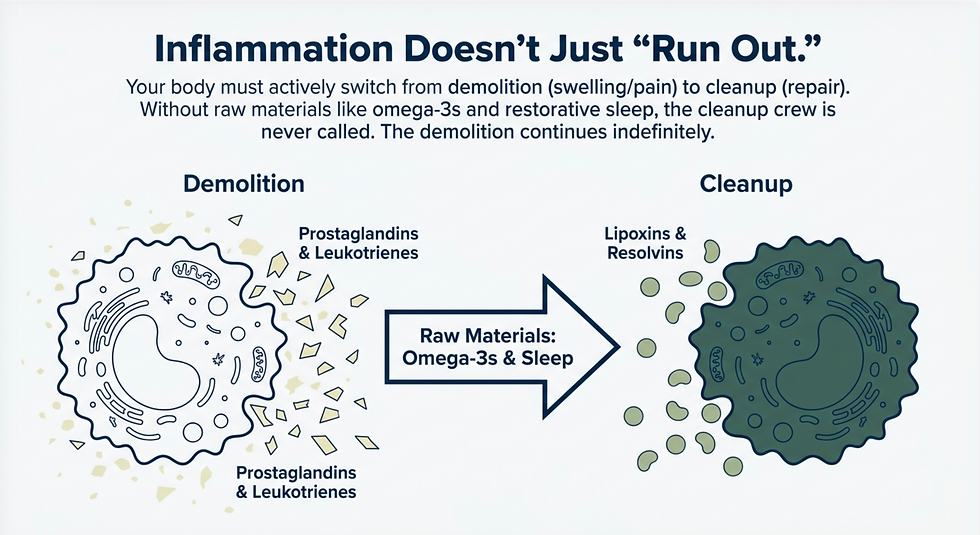
Most anti-inflammatory drugs tell the demolition crew to slow down, which makes you feel better, but feeling better and getting better are not always the same thing. NSAIDs block a pathway that also interferes with some of these resolution signals, which is part of why pain can drag on or bounce back. The better question is whether your body can call in the cleanup crew at all. That depends on raw materials like omega-3s, on sleep, on stable blood sugar, and on whether something like the gut is still feeding the demolition crew.
Why A Shirt, A Shower, Or Your Bedsheets Can Start To Hurt
Your pain nerves carry sensors on their endings, and one of the most important is TRPV1, the same sensor that responds to chili peppers. Its job is to detect heat, acid, and chemical irritants, and under normal conditions it fires at about 109 degrees Fahrenheit, which is hot enough to burn you. That is good design.
Now bathe that nerve ending in what we call the inflammatory soup, which includes prostaglandin E2, bradykinin, nerve growth factor, interleukin-1 beta, and tissue that has become more acidic. Each ingredient lands on its own receptor and triggers enzymes inside the nerve that chemically tag TRPV1, and a tagged sensor fires at a lower temperature, low enough that normal body heat can set it off. Nerve growth factor goes further and instructs the nerve to build more of these sensors and move them to the surface. This is the physiology behind allodynia, the experience of pain from things that should never hurt.

Think of these receptors as a smoke detector that should only sound for a house fire. After inflammation recalibrates it, toast sets it off. NSAIDs lower prostaglandins, and that effect is real, but prostaglandins are one ingredient in a soup with a dozen, and bradykinin and nerve growth factor remain in the pot. The useful question is what keeps making the soup. In chronic pain the answer is usually not damaged tissue. It is diet, lifestyle, poor blood flow to the tissue, and the other mechanisms in this article. You are not oversensitive. The receptors throughout your body have been sensitized to fire at the smallest of stimuli.
Why The Spinal Cord Stops Filtering And Your Pain Spreads
Your brain cannot process every signal that reaches it, including the touch of your clothes on your skin, so your spinal cord decides which information travels upward and which does not. It uses an accelerator and a brake. The accelerator is the neurotransmitter glutamate. The brake is the neurotransmitter GABA together with the amino acid glycine.
Here is how the brake works. When GABA lands on a neuron, it opens a channel that lets negatively charged chloride flood in, which quiets the neuron. This works because the neuron keeps its internal chloride low using a pump called KCC2. Now add inflammation. Microglia, the immune cells of the spinal cord, become activated and release a signal called BDNF, which interferes with that pump. Chloride builds up inside the neuron, so when GABA opens the channel, chloride no longer rushes in and in some cases flows out. The brake does almost nothing, or it excites the neuron. You now have a brake pedal wired to the gas pedal.

At the same time, inflammatory cytokines such as TNF-alpha and interleukin-1 beta make the accelerator more responsive by activating the NMDA receptor, the receptor covered in the article on central sensitization, which then lets through pain signals that a person without chronic pain would have filtered out. Medications like gabapentin can turn down the excitatory side, but they do not touch the microglia driving it. Upstream means looking at what drives the chronic inflammation, including bacterial fragments leaking from the gut (covered below), poor sleep, and chronic stress. This is not weakness and it is not anxiety. It is a spinal cord that inflammation has changed.
Why Nerves Zap And Burn When Nothing Is Touching You
The cell bodies of your pain-sensing nerves sit in small clusters beside the spinal cord called the dorsal root ganglia. These clusters have unusually leaky blood vessels, which means immune cells and inflammatory chemicals can get right up against the nerve cells. A nerve fires when sodium rushes in through specialized sodium channels, and pain nerves have their own. Inflammation increases the number of these channels and makes them open more easily, which lowers the threshold at which the nerve fires.
How much does that matter? People born without a working copy of one of these channels, Nav1.7, cannot feel pain at all, while people with a gain-of-function mutation in the same channel suffer attacks of burning pain. That is a single channel with dramatically different effects depending on how it behaves. Inflammation can also damage the myelin, the insulation around nerves, so that nerves begin to fire even more spontaneously.

It is a doorbell with corroded wiring and a hypersensitive button. It rings with nobody at the door, you go check, and you begin to doubt whether your pain is real. The doorbell is ringing.
Lidocaine works on exactly these sodium channels, which is why it helps, but it blocks the channel without asking why there are so many of them. Upstream means lowering the inflammatory pressure on the nerve, keeping blood flow good, and keeping the tissue around the nerve moving. The pain is real because the signal is real. The signal is being generated in the wrong place.
Why Pain And Low Mood Travel Together
It is more than the idea that chronic pain is depressing, and understanding the mechanism helps you address both. Serotonin is built from the amino acid tryptophan, but tryptophan is a shared resource. Under normal conditions only a small amount travels down the serotonin track, with most of it going down a second track called the kynurenine pathway.
Chronic inflammation makes this worse. Cytokines such as interferon-gamma and TNF-alpha turn up an enzyme called indoleamine 2,3-dioxygenase, or IDO, which drags even more tryptophan onto the kynurenine pathway and leaves less for serotonin. The pathway then continues. In the brain, activated microglia tend to push it toward quinolinic acid, which switches on the NMDA receptor. In a person without chronic pain, this receptor helps filter out insignificant signals so that only the truly painful ones get through, while a hallmark of chronic pain conditions is this receptor staying chronically activated and letting nearly every sensation pass through to the brain.

So one inflammatory switch does two things at once. It drains the serotonin supply that supports mood and the body's pain-dampening systems, and it opens the NMDA receptor further. As covered in the gut series, about 90 percent of serotonin is produced in the gut, which is one reason gut inflammation matters here. Antidepressants that preserve serotonin help some people, and none of this is a reason to stop one that is helping you, but they do not add tryptophan to the train and they do not touch the switch. Upstream, you lower the signals that flip IDO, which means gut-derived inflammation, poor sleep, unstable blood sugar, and chronic stress. Exercise adds something unexpected, because working muscle converts kynurenine into kynurenic acid, a form that cannot cross into the brain.
Why You Feel Flat And Wired At The Same Time
Flat and wired sound like opposite problems, but they share a cause. Start with dopamine. Your brain makes it with an enzyme that cannot run without a helper molecule called tetrahydrobiopterin, or BH4. Chronic inflammation destroys BH4, which means less dopamine. Dopamine is not only about pleasure. It supports motivation and it is part of your natural pain-dampening system, so when it drops you get both the flatness and a lower pain tolerance.
Now the wired part. Glutamate, your main excitatory neurotransmitter, pushes pain signals up toward the brain, and after it fires, astrocytes in the brain are supposed to vacuum it back up. TNF-alpha unplugs that vacuum. Quinolinic acid, the byproduct from the previous section, inhibits it further, opens the NMDA receptor, and prompts microglia to release extra glutamate. Now everything passes through, including signals that should never cause pain.

Medications that act on dopamine signaling, or that quiet excitability like gabapentin, work downstream. They cannot rebuild BH4 and they cannot stop the excess glutamate. Upstream means lowering the oxidative and inflammatory load. Vitamin C and folate help keep BH4 in its usable form, and magnesium is a natural NMDA blocker. These are supportive rather than curative, which is true of any chronic condition, because you need to get several things right at once.
Why Inflammation Can Be High When Your Cortisol Looks Normal Or Even High
Cortisol is your body's most powerful built-in anti-inflammatory hormone. It enters an immune cell, binds the glucocorticoid receptor, carries it to the nucleus, and instructs NF-kB, the master inflammation switch, to stand down.
With chronic pain, nothing is that simple. When inflammation persists, the relationship reverses. Cytokines such as IL-1, IL-6, and TNF-alpha activate enzymes that tag the receptor so it cannot reach the nucleus, and they raise a decoy version called GR-beta that interferes with the working receptor. This is called glucocorticoid resistance. Your brain's stress thermostat, the HPA axis, relies on those same receptors to decide whether to make more or less cortisol. If the receptors are not answering, the brain concludes cortisol is too low and makes more. One action of cortisol is to release stored glucose from glycogen, and if you are not using that glucose through movement, it becomes inflammatory and contributes to damage throughout the body. So yes, you can have high cortisol and high inflammation at the same time.

Corticosteroids such as prednisone and steroid injections work by hitting this same receptor harder. When the receptor is resistant, relief can be weaker or shorter, and higher doses carry real risks. That is not a reason to avoid them when you need them. It is a reason to ask why the receptor is not answering. Upstream is the unglamorous work of consistent sleep, steady blood sugar, stress management practices, and calming the inflammatory signals that jam the receptor in the first place. The signal is being sent, but it is not being received.
Why Your Thyroid Labs Can Look Normal When You Feel Run Down
Your thyroid mostly makes T4, the storage form of thyroid hormone. T4 does very little until enzymes in your tissues remove one of its four iodine atoms and convert it into T3, the hormone that actually runs your cells. Inflammatory cytokines including IL-6, TNF-alpha, and IL-1 slow down these converting enzymes and turn up one called D3, which sends T4 down a different path into reverse T3, an inactive form that does nothing. A screen that checks only TSH is looking at a brain hormone at the top of the pathway, not at what is happening inside your tissues, so everything can read normal while tissue repair slows, muscles ache, and recovery drags on.

Sex hormones take a similar hit. The same cytokines switch on aromatase, the enzyme that turns testosterone into estrogen, particularly in body fat and inflamed connective tissue, and they dampen the brain's signal to make testosterone, which has pain-dampening effects of its own. Replacing a hormone helps when it is truly low, but if inflammation is clamping the conversion, replacing the end product without asking why leaves the loop running. Upstream, selenium is a primary nutrient for these converting enzymes, so it matters, alongside adequate calories and protein, good sleep, and cooling the inflammation itself. Normal labs do not always mean normal function.
Why Healing The Gut Can Ease Pain All Over The Body
Inflammation is not a one-way street in which it causes a problem and then goes away. It is a self-perpetuating loop, and one of its main engines sits in a place most chronic pain specialists never treat, which is the gut.
The lining of your small intestine is one cell thick, and those cells are held together by proteins called tight junctions that form a sealed barrier. Inflammatory signals such as TNF-alpha and interferon-gamma, which also impair tissue healing, neurotransmitter synthesis, and nerve conduction, loosen those tight junctions as well. Gaps open between the cells, and undigested food particles and bacterial fragments called LPS pass directly into your bloodstream. LPS docks onto TLR4, a receptor on immune and liver cells, which fires up NF-kB and produces more TNF-alpha. That new TNF-alpha travels back to the gut and loosens the junctions further.

This is part of why an anti-inflammatory alone often plateaus. It turns down NF-kB downstream while LPS keeps crossing upstream and relighting the fire. Even when gut symptoms are treated, it is worth asking whether the treatment addresses the structural integrity of the intestinal lining or only manages the bloating and diarrhea. Looking upstream means supporting the lining with adequate fiber, zinc, and L-glutamine, and treating whatever irritates it, whether that is food sensitivities, dysbiosis, or chronic stress, since stress hormones loosen the same tight junctions.
Why Body Pain Comes With Brain Fog
Brain fog, mental fatigue, and a flat mood tend to flare when your pain does, and there is a physical reason. Your brain has its own security wall, the blood-brain barrier, similar to the gut lining but sealed even more tightly so that very few things pass from your bloodstream into your brain.
The same inflammatory cytokines that make your gut lining permeable also loosen the seal on this barrier, allowing inflammation through directly. They can also signal across an intact barrier using transport proteins, so the message gets through either way. On the other side sit microglia, the brain's resident immune cells, which pick up the signal, activate, and release their own cytokines inside the brain. Inflammation that began in your gut, your joints, or anywhere else is effectively forwarded to brain tissue. The fog, the exhaustion, the low motivation, and the low mood that show up alongside a flare are due to neuroinflammation.

Antidepressants work on chemistry inside the brain. They do not reinforce the wall or quiet the microglia on the other side. Upstream means lowering what crosses the wall in the first place, which includes systemic inflammation, the gut loop described above, and chronic stress, which also weakens those seals.
Why Deep Breathing Does Not Always Calm Your Pain
The vagus nerve is the longest cranial nerve in the body, and part of its job is to put the brakes on inflammation. Researchers call this the cholinergic anti-inflammatory pathway. When the vagus nerve fires, it releases the neurotransmitter acetylcholine, which docks onto a receptor on immune cells, especially macrophages in the spleen, and tells them to stop producing TNF-alpha. It is a direct nerve-to-immune-cell brake line, not a hormone drifting through the blood in search of a target.

Here is the part that matters. Chronic inflammation weakens this system. Persistently high cytokines are linked to lower vagal tone, so the very condition the brake is meant to control also wears the brake down. Slow, extended exhales mechanically stimulate the vagus nerve and can measurably raise vagal tone over time, which connects to the breathing physiology covered in the earlier article on the Bohr effect. But when inflammation is high enough, a single breathing session is like pressing a brake pedal with a snapped brake line. That is why breath work is more effective when practiced regularly outside of flares than during them. Add it to your daily routine, especially on the good days, because that is when it is easiest to forget.
Why One Bad Night Of Sleep Can Wreck Your Pain For Days
Deep sleep is not passive downtime. It is when your glymphatic system, the brain's cleanup system, runs its most active cycle to clear metabolic waste, and it is when growth hormone release and tissue repair peak. The inconvenient part is that the cytokines IL-6 and TNF-alpha directly fragment deep sleep, pulling you into lighter stages more often. Pain wakes you up, but the cytokines also interfere with the architecture of sleep itself. Because those cytokines are systemic, they can originate in places that do not hurt, such as the gut, which is why the cause is easy to miss.

The loop is self-perpetuating. One night of shortened deep sleep measurably raises IL-6 and TNF-alpha the next day, in healthy people as well as in people with chronic pain, and higher cytokines produce worse sleep. That next-day inflammation also lowers your pain threshold through the sensitized-nerve and central sensitization mechanisms described above, so a rough night turns up your sensitivity the following day and can echo for several days while your system resets. Sleep medications produce unconsciousness, but they do not restore the deep, slow-wave stage this repair depends on, so they do not fully break the loop.
Why Injured Tissue Heals So Slowly When You Are Inflamed
Every cell in your body runs on an energy currency called ATP, and mitochondria make it. Repair, which includes building new collagen, clearing debris, and generating new tissue, is among the most energy-expensive work your body does. Chronic inflammation produces reactive oxygen species, or ROS, which are free radicals that physically damage mitochondria. Damaged mitochondria make less ATP and leak more ROS themselves.
They also release their contents in a way that your immune system reads as a danger signal. An activated immune system releases more inflammation, which makes more ROS, which damages more mitochondria. Picture a construction site running on a failing generator. The crew is there and willing to work, but the power keeps cutting out, so the job falls behind.

This is part of why rest alone sometimes is not enough. Rest allows you to bank energy, but only if you are producing enough energy to begin with. Anti-inflammatories can quiet the signal, but they do not restore the power plant. Upstream support means the basics that feed mitochondrial repair, which are adequate protein, B vitamins, and CoQ10, along with good sleep, since much of this repair happens then, and lowering the inflammatory load that generates the ROS in the first place. Slow healing is not always about willpower or effort. Sometimes it is about whether the tissue has the power to do the work.
Why Pain Gets Worse In The Cold Or After Sitting Still
The inner lining of your blood vessels, the endothelium, is not a passive pipe. It actively controls how much blood reaches your tissue, partly by releasing nitric oxide, which tells the vessel to relax and widen.
Here is the part that gets ignored in conventional chronic pain settings. Chronic inflammation damages this lining and reduces nitric oxide production, so vessels become stiffer and less responsive, and tissue does not receive the extra blood flow it needs. Researchers call this endothelial dysfunction, and it shows up on vascular testing in several chronic pain conditions. Less blood flow means less oxygen reaching the tissue. Biopsies of fibromyalgia tender points show measurably lower oxygen levels than normal tissue, and while those studies are specific to fibromyalgia, the vascular physiology is not unique to it. Low-oxygen tissue produces less energy for healing and more of the chemicals, such as bradykinin and lactic acid, that sensitize nerves.

Cold and stillness both narrow vessels further, so layered on top of chronic inflammation they make pain worse. Heat, movement, and massage help partly by mechanically improving local blood flow. They do not fix the underlying endothelial dysfunction, but they do address the immediate oxygen shortage. Upstream, movement, omega-3s, curcumin, resveratrol, and good sleep support vascular health. Some of your pain may be tissue that is running low on oxygen.
Why Your Muscles Feel Thick, Stiff, And Rope-Like
When a muscle will not release no matter what you do, the problem is often the fascia and not the muscle itself. Fascia is the web-like connective tissue wrapped around your muscles, and it is maintained by cells called fibroblasts that constantly build and break down collagen in a balanced way. Chronic inflammation disrupts that balance by releasing TGF-beta, which converts ordinary fibroblasts into myofibroblasts. These are not only repair cells. They contain the same contractile protein found in muscle, and they generate their own sustained mechanical tension independent of any nerve signal.

That is the part that surprises people. As covered in the earlier article on trigger points and fascia, this tightness is not your nervous system holding a muscle in spasm. It is tissue that has physically remodeled itself into a semi-permanent contracted state, like a tent with the guy-ropes cinched far tighter than needed, pulling the whole structure out of shape. Muscle relaxers work on nerve signaling to the muscle, but they do not reverse fibroblasts that have already remodeled. Manual therapies, especially dry needling, target the tissue directly. For lasting results, the inflammatory signal driving TGF-beta has to come down as well.
Why Carrying Extra Weight Makes Pain Harder To Control
For a long time adipose tissue was thought of as passive storage. We now know it actively secretes hormones and inflammatory signals, including IL-6 and TNF-alpha, in proportion to how much of it a person carries. Here is what most people have never heard. This means fat tissue functions as an inflammatory gland, releasing signals system-wide, which is part of why inflammation-driven pain does not stay contained to one joint or one area.

TNF-alpha also directly interferes with insulin signaling. Insulin binds its receptor, but the door does not open and the message does not get relayed. This is insulin resistance, and tissue that is insulin resistant has a harder time repairing. A self-sustaining loop forms. More adipose tissue means more inflammation, which worsens insulin resistance, which impairs tissue repair, which can mean more pain and less movement, which often means more weight. This is biology and not a character flaw, and it is one reason the loop is hard to break through willpower alone. Metformin and other medications target the insulin signaling piece directly and are useful tools, but they do not turn down the fat tissue's inflammatory output. Pain is not only local. Most often it is being fed from tissue far from where it hurts.
Why No Single Treatment Reaches Every Room
Across these sixteen mechanisms, one flame has moved through the rooms of the same house, and it never stays in one. It sensitizes the nerve endings in your tissue. It weakens the spinal brake that is supposed to limit pain signals. It opens the gate in your gut, which feeds right back into itself. It jams the lock on your cortisol receptor and clamps the fuel line to your thyroid. It stiffens your blood vessels and starves tissue of oxygen. It converts ordinary fibroblasts into tissue that pulls itself tight. It damages the power plants your cells need to repair themselves, and fat tissue can become another source feeding the fire.

These rooms are not separate. The gut feeds the brain, the brain feeds the spinal cord, the hormones feed the vessels, the vessels feed the tissue, and nearly all of them feed back into more inflammation. That is why a single pill aimed at a single room rarely resolves chronic pain. It can help in that one room while the fire keeps burning in the others. It is also why the approach at True Health Centers works on several of these layers together, starting with the most upstream ones. Chronic pain was never one thing. It is the accumulation of too many things going wrong in the same direction at once.
The Bottom Line
You are not imagining your pain, and you are not oversensitive. You are living with inflammation that was never given the signal to stop, and over time it has changed your nerves, your spinal cord, your brain chemistry, and your tissue in ways no single medication was built to reach.
Your pain is real because the signal is real, and the most useful question is not which pill to add next but what is keeping the inflammation lit upstream.

Written By:
Dr. Jason Winkelmann
Naturopathic doctor, Chiropractor, Chronic Pain Specialist, and Educator
Frequently Asked Questions
Why don't anti-inflammatory medications fix chronic inflammation?
Anti-inflammatory medications lower specific signals, and that effect is real and useful. NSAIDs reduce prostaglandins, and steroids activate the cortisol receptor. Chronic inflammation involves many other signals at once, including bradykinin, nerve growth factor, cytokines, and gut-derived LPS, and some drugs interfere with the body's own resolution signals or work less well when the receptor is resistant. They can help you feel better while the drivers keep running. If a medication is helping you, continue it and discuss any changes with your prescriber, and ask what is keeping the inflammation lit upstream.
Why does my chronic pain change from day to day for no clear reason?
The inputs that feed inflammation change daily even when you cannot feel them. One night of poor sleep measurably raises IL-6 and TNF-alpha the next day, blood sugar swings alter inflammatory signaling, gut permeability shifts with food and stress, and vagal tone rises and falls. Sensitized nerves and a weakened spinal brake amplify each of those changes, so small shifts in inflammation can produce large shifts in pain. The variation is physiology, not imagination.
Why are my labs normal if inflammation is affecting my body?
Standard screens often measure the top of a pathway rather than what happens in tissue. A TSH checks a brain hormone, not how well T4 is converted to active T3 in your tissues. A cortisol level shows how much hormone is present, not whether the receptor is responding to it, and in glucocorticoid resistance cortisol can be normal or high while inflammation stays high. Normal labs mean the measured step is within range. They do not rule out a problem at the steps that were not measured, so a more complete evaluation with a provider who understands these pathways is reasonable.
What can I do about chronic inflammation besides medication?
Start with the inputs that keep inflammation running or prevent its resolution, which are consistent sleep, steady blood sugar, adequate protein and calories, omega-3 fatty acids, support for the gut lining with fiber, zinc, and L-glutamine, regular movement, a daily breathing practice, and stress management. These work with your biology rather than around it, and in any single room they are less potent than a drug. Their value comes from addressing several rooms at once. Work with a provider to prioritize them, and do not stop prescribed medication without discussing it with your prescriber.
How can inflammation elsewhere in my body affect my brain and mood?
Inflammatory cytokines loosen the blood-brain barrier and can also signal across it through transport proteins. Microglia then activate and release their own cytokines inside the brain, which produces neuroinflammation experienced as fog, fatigue, and low mood. Inflammation also diverts tryptophan away from serotonin down the kynurenine pathway through IDO, lowers dopamine by destroying BH4, and impairs glutamate clearance. Body pain and mood symptoms flare together because they share a cause.


Comments