
Why Your Hormone Levels Aren't Telling You the Whole Story About Chronic Pain

Updated: Aug 21

TL;DR
If your pain shifts throughout your menstrual cycle, spikes around ovulation, or changed dramatically during perimenopause or menopause, you have probably been told it is "hormonal" and left with nothing more useful than that. It is true, but it is also incomplete in a way that matters. Estrogen does not simply help or hurt your pain. It has a biphasic effect that flips based on concentration, which is why a sudden drop, not a low level, is often what triggers a migraine. Progesterone's pain relief depends on which metabolite your liver converts it into. Estrogen's protective effect depends on whether your genetics can methylate it into the right form. And underneath all of it, chronic stress can quietly redirect your hormone production away from pain protection entirely. This article walks through the actual physiology, the same pathways that explain why hormone replacement therapy sometimes backfires and why your pain can vary from one day to the next even when nothing else in your life has changed.
What Most Patients Are Told
If you have brought up pain that changes with your cycle, or pain that worsened around perimenopause, there is a good chance you were told it is "hormonal" and that was more or less the end of the conversation. Maybe you were offered hormone replacement therapy. Maybe you were told to track your cycle and just expect flare ups. Either way, you were given a label, not an explanation.
That label is not wrong. Your hormones are involved. But "hormonal" is not a mechanism, it is a shrug dressed up as a diagnosis. It does not tell you why estrogen can protect you against pain in one part of your cycle and provoke it in another. It does not tell you why hormone replacement therapy sometimes makes pain worse instead of better. And it does not tell you why chronic stress, something almost never discussed in the same conversation as hormone testing, can be quietly sabotaging the whole system.

Where The Conventional Explanation Breaks Down
Conventional hormone testing typically measures total estrogen, progesterone, and testosterone levels in your blood. That is useful information, but it treats these hormones as if they act the same way regardless of concentration, regardless of what they get converted into, and regardless of what else is competing for the raw materials used to build them.
None of that is true. Estrogen's effect on pain depends on where it sits on a curve, not just whether it is "high" or "low." Progesterone's calming effect depends on a downstream metabolite, not progesterone itself. And your body can only make so much of these hormones from a limited supply of cholesterol, which means chronic stress can literally steal the raw material your body needs to make them. A blood test that reports a single number cannot capture any of that. This is where the real explanation begins.
The Estrogen Paradox: Why More Isn't Always Better
Estrogen does not have a single, consistent effect on pain. It has a biphasic effect, meaning the direction it pushes your pain depends entirely on its concentration. At higher concentrations, estrogen strengthens your descending pain pathways, the system in your spinal cord that acts like a filter, screening out minor, insignificant pain signals so that only the truly important ones reach your brain. At these higher concentrations, your body also releases enkephalins, natural pain relieving chemicals closely related to endorphins.
But at lower concentrations, estrogen does not simply lose this protective effect. It flips. Low estrogen actively promotes pain rather than suppressing it. This is the part almost no one explains, and it is the reason a single blood test showing "normal" estrogen tells you almost nothing about how your pain will behave that week.

What Menstrual Migraines Reveal About Estrogen Withdrawal
The clearest illustration of this flip is the menstrual migraine. From roughly day zero to day fourteen of your cycle, estrogen rises steadily, and you get the protective benefits described above. Around day fourteen, near ovulation, estrogen drops suddenly. That sudden withdrawal, not a low level on its own, is what activates the trigeminal nerve system, triggering the release of CGRP, the molecule responsible for most of the pain in a migraine.
This distinction matters clinically. If estrogen withdrawal, not estrogen deficiency, is the trigger, then the goal is not simply to raise estrogen levels. It is to stabilize the pattern of rise and fall.

Progesterone, GABA, and Why Pregnancy Often Eases Pain
Progesterone works through a different mechanism. When its levels rise, it increases GABA, your primary calming neurotransmitter. This is part of why, a few days after an estrogen withdrawal migraine, when progesterone rises, many people get relief. It also explains something patients frequently report but rarely get an explanation for: chronic pain often improves during pregnancy, when progesterone remains elevated for months.
But this explanation, while accurate, is still incomplete. Progesterone itself is not what is doing the work.
It Is Not the Hormone, It Is the Metabolite
Here is what almost never gets explained in a conventional visit. Your body is constantly converting these hormones into other forms, called metabolites, and it is the metabolites, not the parent hormones, that actually determine your pain levels.
This entire pathway starts with cholesterol. If your cholesterol is naturally low, or if a well meaning doctor has driven it down aggressively because "lower is better," that becomes a real problem, because cholesterol converts into pregnenolone, and pregnenolone is the starting material for both progesterone and, eventually, estrogen and testosterone.
Progesterone itself gets metabolized in the liver into two different forms, called the alpha and beta metabolites. It is specifically the alpha metabolite, converted into allopregnanolone, that raises GABA and produces the calming, pain reducing effect. Progesterone that the liver converts into the beta metabolite does not deliver the same benefit.

The Estrogen Metabolite That Actually Matters
Estrogen follows its own, more complicated conversion path. Pregnenolone can convert into DHEA, which becomes testosterone, which becomes estrogen. There are three types of estrogen, and the first type, E1, can be further metabolized into several different downstream forms. This is where the assumption that "more estrogen is better" breaks down. One of these metabolites tends to push the body toward more pain (4-OH), while another is more protective (2-OH).
But even the protective metabolite is not the one doing the real work. That metabolite has to be methylated, a chemical modification largely controlled by your COMT gene, into 2-methoxyestradiol, and it is this final, methylated form that provides the strongest pain protective effect. This ties back to something covered in an earlier piece in this library on the COMT gene: a common genetic variant makes this methylation process sluggish. You can have plenty of the intermediate metabolite available and still fail to convert enough of it into the form that actually protects you from pain.

This also explains a frustrating pattern some patients experience. If a blood test shows low estrogen and the response is hormone replacement therapy, but your body has a genetic tendency to convert extra estrogen into the pain promoting metabolite rather than the protective, methylated one, adding more estrogen can make the pain worse instead of better. The hormone level went up. The mechanism that actually matters did not.
The Pregnenolone Steal: How Chronic Stress Hijacks the System
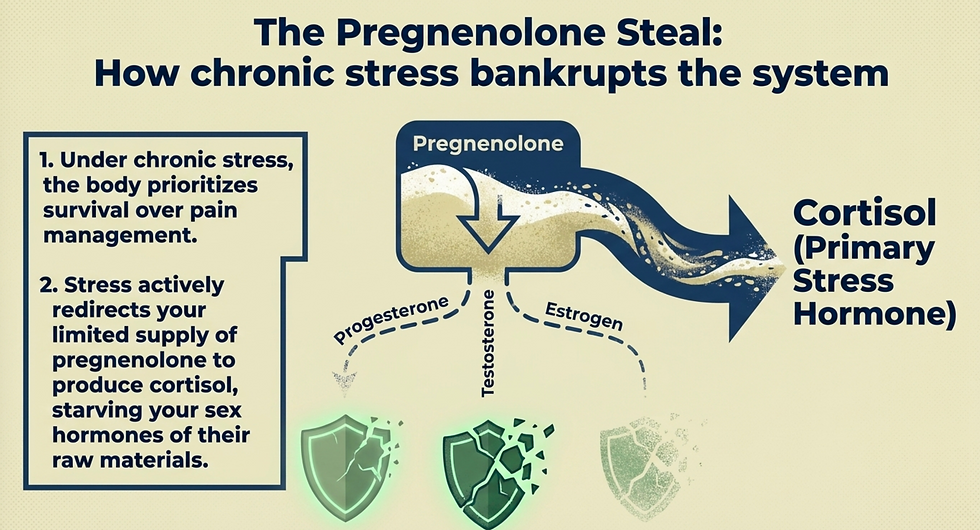
There is a third piece to this pathway that rarely comes up in a hormone conversation at all: cortisol. Pregnenolone, the same starting material that becomes progesterone and eventually estrogen, is also used to make cortisol, your primary stress hormone.
When you are under chronic stress: physical, biochemical, or emotional, your body prioritizes cortisol production. This is sometimes called the pregnenolone steal. Available pregnenolone gets redirected toward making cortisol at the expense of making progesterone and estrogen, which means chronic stress does not just add a separate layer of tension on top of your pain. It actively siphons away the raw material your body needs to produce the hormones and metabolites that protect you from pain in the first place.
This is the core distinction between a provider who is treating your pain and one who is treating you. If cortisol levels, liver metabolism, and methylation genetics are never part of the conversation, the treatment is managing a symptom rather than addressing what is generating it.
Testosterone and the Brain's Pain Filter
Testosterone is independently protective against chronic pain, through a completely different route. Every second of every day, thousands of sensory inputs are trying to reach your brain. Your brain cannot afford to process each and every signal, especially minor, insignificant pain signals, so it relies on a filtering system called the suprapinal pain modulatory circuitry.
This system starts in a region called the periaqueductal gray, mentioned in earlier pieces in this library, which is dense with testosterone receptors. When testosterone binds there, it activates a downstream region that sends signals to the dorsal horn of your spinal cord, the crossing point where incoming pain information first arrives. Your descending pain pathways operate here, effectively building a wall that keeps insignificant pain signals from reaching your brain.
When testosterone is low, that wall weakens. Pain signals, important or not, get through with far less resistance.

Why You Might Not Be Making Enough Testosterone
Everyone, not only men, needs adequate testosterone to keep this filtering system functioning. A few things commonly interfere with it. As chronic pain leads to more sedentary behavior, muscle tissue atrophies, and testosterone production drops with it. Low cholesterol, the same starting material discussed earlier, limits how much testosterone your body can produce at all. And the pregnenolone steal described above applies here too. If your available pregnenolone is being redirected toward cortisol production under chronic stress, there is less left over to build testosterone.
If a provider is not evaluating the full picture of these interconnected hormone pathways, testosterone is often the piece that gets missed entirely, and the pain filtering system built on it suffers as a result.

Stress, Cortisol, and the Flip From Pain-Protective to Pain-Promoting
You have almost certainly been told that stress contributes to your pain. What you likely have not been told is the specific mechanism, and that gap is exactly what keeps this advice from being actionable.
Signals traveling from the rest of your body toward your brain pass first through the dorsal root ganglion, then into the dorsal horn of your spinal cord, the same filtering region discussed above. Both areas contain a high concentration of glucocorticoid receptors.
When your brain registers stress: physical, biochemical, or emotional, it signals your adrenal glands to release cortisol, which binds to these receptors. In the short term, this reduces inflammation and helps keep pain signals from reaching your brain.
The distinction that matters is that these receptors are dose and time dependent. In an acute stress response, they protect you. But with sustained, elevated cortisol, these same receptors get phosphorylated and functionally flip, shifting from antinociceptive, meaning pain suppressing, to pronociceptive, meaning pain promoting. Once that shift happens, downstream immune activity increases, and your immune system does what it does best. NF-kB and the NLRP3 inflammasome, two chronic inflammatory pathways covered in earlier pieces in this library, get activated and promote more inflammation. That increased inflammation sensitizes your pain receptors further, so you end up feeling more pain from less stimulus over time.
This is not only about emotional stress. Physical stressors like joint restrictions and chronically tight muscles, and biochemical stressors like an inflammatory diet, food sensitivities, or a disrupted gut microbiome, all raise cortisol the same way. Which means the stress side of this equation has to be treated on every one of those fronts, not managed with a single relaxation technique and considered handled.

The Bottom Line
Your pain is not simply "hormonal," and it was never going to be fixed by a single blood test and a prescription. The hormones themselves are only the starting material. What actually determines your pain, day to day and cycle to cycle, is how those hormones are metabolized in your liver, how efficiently your genetics can convert them into their protective forms, and how much of your body's raw material is being diverted toward managing chronic stress instead.
The real question was never whether your hormone levels are normal. It is whether your body can actually convert and use them in the way that protects you from pain.

Written By:
Dr. Jason Winkelmann
Naturopathic doctor, Chiropractor, Chronic Pain Specialist, and Educator
Frequently Asked Questions
My hormone panel came back normal. Why does my provider say hormones aren't part of my chronic pain?
A standard hormone panel measures total circulating levels of estrogen, progesterone, and testosterone. It does not measure how efficiently those hormones are being converted into the specific metabolites that actually influence pain, such as allopregnanolone or 2-methoxyestradiol, and it does not account for genetic differences in methylation through the COMT gene. Normal total hormone levels do not rule out a hormone driven pain mechanism. They simply mean the standard test was not designed to look deep enough to find it.
Why does my pain get worse right before or during my period instead of staying consistent?
This pattern typically lines up with the sudden drop in estrogen around ovulation and again before menstruation. That withdrawal, not a low level of estrogen on its own, activates the trigeminal nerve system and triggers the release of CGRP, which is directly tied to migraine and pain flares. The steadiness of your hormone pattern, not just the levels themselves, plays a major role in how stable your pain stays.
I started hormone replacement therapy for low estrogen, but my pain got worse. How is that possible?
This can happen when your body has a genetic tendency, often tied to COMT methylation efficiency, to convert additional estrogen into a metabolite that promotes pain rather than the protective, methylated form. Raising total estrogen without addressing how it is being metabolized can shift the balance in the wrong direction. This is one of the clearest examples of why treating a single number rather than the full pathway can backfire.
If it's this complicated, what can I actually do about it?
The starting point is addressing the pathway as a whole rather than a single hormone level. That includes supporting adequate cholesterol as the raw material for hormone production, actively managing chronic stress so cortisol is not continuously stealing pregnenolone away from progesterone and estrogen production, and supporting the liver and methylation processes that convert hormones into their protective metabolites. This is addressed through a comprehensive evaluation rather than a single prescription, which is exactly where an all inclusive approach to chronic pain differs from standard hormone management.
Can stress really affect my hormones enough to change my pain levels?
Yes, through a specific mechanism called the pregnenolone steal. Pregnenolone is the shared starting material for both cortisol and your sex hormones. Under chronic stress, your body prioritizes cortisol production, leaving less pregnenolone available to produce the progesterone, estrogen, and testosterone that protect you from pain. On top of that, chronically elevated cortisol eventually causes your glucocorticoid receptors to flip from reducing pain and inflammation to promoting them. Stress is not a separate issue from your hormonal pain pattern. It is directly upstream of it.


Comments