
How Does Pain Work? And What Goes Wrong in Chronic Pain?


TL;DR
Pain is not a direct readout of tissue damage. Between every injury and your awareness of it sits a three-part filter built into your spinal cord and brain, made of inhibitory interneurons, the NMDA receptor, and descending inhibition. In acute pain, this filter works exactly as designed. In chronic pain, each layer weakens, so signals that should have been filtered out reach your brain and get processed as pain. This article walks through how the pathway works, where each filter lives, and why the breakdown has physical, biochemical, and emotional causes, each of which is a real physiological process that can be explained and influenced.
What Most Patients Are Told
If you have lived with pain for months or years, you have probably heard some version of the same explanation. Pain means something is damaged. If the scan looks normal, the damage must be minor. If the pain is still there anyway, it may be stress, or aging, or something you will need to manage with medication.
That explanation is not malicious, and it is not entirely wrong. Tissue damage can cause pain. But it leaves out the single most important step in the entire process, and without that step, a normal scan alongside severe pain sounds like a contradiction. It is not a contradiction. It is a sign that the explanation you were given stops one step too early.
Where The Conventional Explanation Breaks Down
Think about bumping your elbow on a door frame versus cutting your finger. Those two experiences feel completely different; but not for the reason you'd think. The interesting thing about nerves is that they don't have a dimmer switch. They can't make a signal stronger or weaker. Nerves fire at 100% intensity each time they fire. How much of that signal reaches your awareness, and how bad it feels when it arrives, is decided by what happens after the nerve fires.

Between the injury and your brain, you have a filter. It decides how much of the signal gets through to be processed as pain. The damage-equals-pain model skips the filter entirely, which is why it cannot explain pain that outlasts its cause, pain that flares for no visible reason, or pain that a scan cannot find. The filter is the missing piece, and it is the most important mechanism in understanding chronic pain.
The Route: From Tissue to Spinal Cord
Pain typically begins at a nociceptor, a nerve ending that detects a threat to your tissue, such as extreme heat, pressure, or chemical irritation. When enough of that threat is detected, the nerve fires. That electrical impulse is called an action potential, and it travels up toward your spinal cord.

The key detail is that this is not one continuous nerve running all the way to your brain. The first nerve ends in the spinal cord, where it passes the signal along by releasing glutamate, an excitatory neurotransmitter, a chemical messenger that tells the next nerve to fire. That second nerve carries the signal up to the brain. These are referred to as the first and second order neurons. This handoff in the spinal cord is where the filters live, which means your nervous system gets to edit the message before your brain ever sees it.
Filter One: The Inhibitory Interneurons
The first filter is made of inhibitory interneurons, small nerve cells in the spinal cord whose entire job is to turn the volume down. They release GABA and glycine, inhibitory neurotransmitters, the main calming chemicals in the spinal cord. GABA and glycine do two things at the handoff: they reduce how much glutamate the first order neuron releases, and they make the second order neuron harder to fire.

This is why your instinct is to rub your elbow after you bump it. The touch fibers in your skin activate these interneurons, which turn down the signal at the spinal cord handoff for a moment. The relief is not a distraction or a placebo. It is your own inhibitory circuitry being switched on from the outside.
Filter Two: The NMDA Receptor
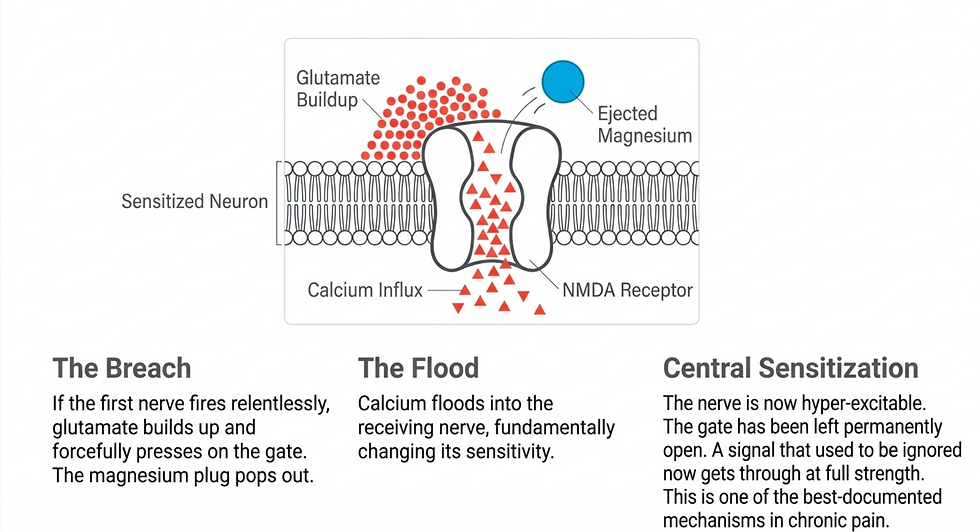
The second filter is the NMDA receptor, which works like a gate on the second order neuron. Under normal conditions the gate is closed, because the receptor is plugged by a magnesium ion. A small amount of glutamate is not enough to open it, so a brief signal fades without being amplified.

If the first nerve keeps firing, however, glutamate builds up and presses on that gate. The magnesium plug pops out, and calcium floods into the receiving nerve. Now that nerve is easier to excite and responds more strongly to the very same input. The gate has been left open, and a signal that used to be ignored now gets through at full strength. This process, called central sensitization, is one of the best documented mechanisms in chronic pain.
What Happens When the Signal Reaches the Brain
When the signal arrives in the brain, it first passes through the thalamus, a relay station for sensory information. From there, third order neurons, the third nerve in this pathway, split into two routes, and the difference between them explains something most patients have never been told.

One route goes to the somatosensory cortex, which works out where it hurts and how intense the sensation is. This is the map of the pain. The second route travels through the medial thalamus to the anterior cingulate cortex, the insula, and the amygdala, areas that connect sensation to emotion, threat, and memory. This route builds the unpleasantness, the urgency, and the fear that come with pain. Meanwhile the prefrontal cortex adds context and directs your attention. Lastly, the hippocampus checks the signal against what you have experienced before.

This means emotion and learned experience are not extras layered on top of pain. They are built into the pain pathway itself, in plain neurophysiology. A pain that your brain has learned to associate with danger is processed differently from the same signal in a brain that has learned it is safe.
Filter Three: Descending Inhibition
The third filter starts in those same brain areas. Without any conscious effort, your brain is constantly judging how dangerous an incoming signal really is, using context and memory. If it decides the threat to your life is low, it sends signals back down the spinal cord that press the brakes, and your body releases its own pain-relieving chemicals, including opioids. This is descending inhibition.

It also works in reverse. When your brain decides you are in danger, or has learned that this particular pain means trouble, the brakes come off. The same signal that would have been dampened is now passed through at full volume, because the brain has judged it important.
When The Filter Breaks Down
Everything above applies to both acute and chronic pain. In acute pain, the filter does its job: signals are dampened, the gate stays closed, and the brakes engage once the threat has passed. So what makes pain chronic?

In chronic pain, the filter breaks down at all three layers. The interneurons stop intervening, the NMDA gate stays open, and the brain's brakes weaken. Signals that should have been filtered out reach your brain and get processed as pain.

That breakdown has three kinds of causes: physical, biochemical, and emotional. The physical causes include muscle tension, poor blood flow, and tissue that stays irritated. The biochemical causes include inflammation, blood sugar problems, nutrient gaps, neurotransmitter and hormonal changes. The emotional causes include chronic stress, fear, and what your brain has learned to expect from pain. Each of these is a real physiological process rather than a character flaw or an imagined problem, which means each one can be explained, and each one can be influenced.
The Bottom Line
Your pain is real, but it is not a measurement of how much damage your body has sustained. It is the output of a filter, and in chronic pain that filter has stopped working the way it was designed to. That is a very different problem than "your imaging is negative," and it has very different solutions.
The question was never whether you are damaged. The question is why a filter built to protect you stopped filtering, and which of its three layers needs to be restored first.

Written By:
Dr. Jason Winkelmann
Naturopathic doctor, Chiropractor, Chronic Pain Specialist, and Educator
Frequently Asked Questions
If nerves fire the same way every time, why does my pain change from day to day?
Because the filter, not the nerve, controls how much of the signal reaches your brain. Inflammation levels, stress, sleep, blood sugar, and the emotional state of your brain all change how strongly the interneurons, the NMDA receptor, and descending inhibition are working on any given day. The same signal can be filtered heavily on one day and barely filtered on another.
Does this mean my chronic pain is all in my head?
No. Every step described here is measurable physiology, from the glutamate released in the spinal cord to the calcium flowing through an unblocked NMDA receptor. The brain's involvement does not make the pain imaginary. It means the pain is produced by a nervous system whose filter has changed, which is a biological problem with biological causes.
What is the difference between acute and chronic pain in this model?
The pathway is the same in both. In acute pain, the filter is intact and the pain fades as the tissue heals. In chronic pain, the interneurons, the NMDA gate, and descending inhibition no longer regulate the signal properly, so pain persists or amplifies even after the original injury has resolved or when no clear injury can be found.
Why did my scan come back normal when I am in so much pain?
Imaging shows structure, not the behavior of the filter. A spinal cord with weakened interneurons, an open NMDA gate, and reduced descending inhibition can look completely normal on a scan while processing ordinary input as pain. A normal scan rules out certain structural problems. It does not rule out a filtering problem.
Can the filter be restored?
Because the breakdown has physical, biochemical, and emotional contributors, and each is a real physiological process, each can be influenced. Chronic pain is rarely caused by one thing, so restoring the filter usually means addressing several contributors together rather than relying on a single treatment aimed at the signal.


Comments