
Why Isn't Stretching Fixing My Plantar Fasciitis?


Stretching improves flexibility, but degenerated plantar fascia is not short. It is disorganized and under-repaired, so stretching gives it little signal to rebuild. Repair depends on progressive, graded loading, along with correcting the calf, hip, and foot mechanics that keep overloading the tissue.
Stretching every morning for months and having little to show for it is demoralizing, especially when you were told it was the most important thing you could do.
The Mechanism
The advice to stretch rests on a reasonable idea: a tight calf and tight fascia pull on the heel. Limited ankle dorsiflexion, the ability of the shin to tip forward over the planted foot, does raise tension through the Achilles into the heel, so mobility matters. The problem is what stretching can and cannot do to degenerated tissue. Stretching lengthens tissue temporarily. It does not tell the cells to build anything.

Building requires mechanotransduction, the process by which tendon and fascia cells sense mechanical load and respond by producing new, organized collagen. The signal that triggers it is tension that is heavy enough and slow enough to challenge the tissue without overwhelming it. In a randomized trial, people who did slow, high-load calf raises with the toes elevated on a towel had better outcomes at three months than people who did plantar fascia stretching, which suggests load is the stronger repair signal.

Dose is the catch. Too little load leaves degenerated fibers exactly as they are, and too much breaks them down faster than the tissue rebuilds, which is why rest alone and an aggressive return to activity both fail. The right dose depends on how irritable the tissue is and on what is overloading it, including weak hip muscles that flatten the arch and internal factors such as nutrient status that limit collagen production. Stretching keeps a supporting role, since it eases morning stiffness, but it cannot carry the repair.

When It's Something More Serious
Heel pain with sudden severe onset, a pop, swelling, bruising, or an inability to bear weight needs prompt evaluation. Pain that squeezes tight when you compress the sides of the heel, pain that persists at rest or at night, and burning, tingling, or numbness in the foot are worth having examined, since they can point to a stress fracture or nerve involvement instead of fasciopathy.
How This Gets Addressed
Treatment replaces passive stretching with a repair stimulus and removes what keeps overloading the tissue.
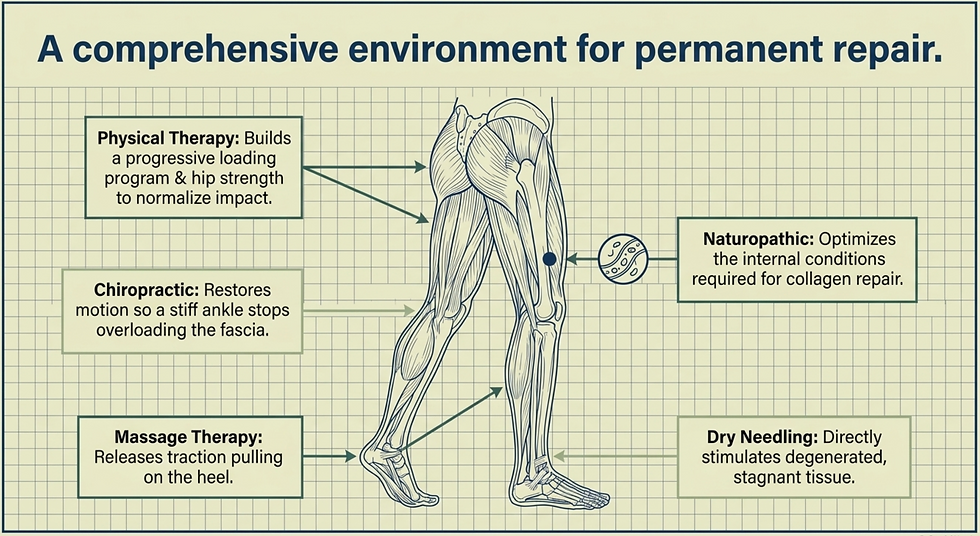
Chiropractic care restores ankle and foot joint motion, so a stiff ankle stops forcing the fascia to absorb extra force, and massage therapy releases the calf and small foot muscles that keep traction on the heel.
Dry needling directly stimulates the degenerated tissue, while physical therapy builds a progressive loading program dosed to your stage, along with hip strengthening to normalize how load reaches the heel.
Naturopathic medicine evaluates the internal factors that decide whether the loading actually produces repair.
You can learn more about our full approach to plantar fasciitis here.
Most patients notice steady improvement over several weeks to a few months once loading is dosed to the tissue and the calf and hip contributors are corrected, although a long-standing heel may plateau if the internal conditions for collagen repair are not addressed.

Written By:
Dr. Jason Winkelmann
Naturopathic doctor, Chiropractor, Chronic Pain Specialist, and Educator
Frequently Asked Questions
Is stretching bad for plantar fasciitis?
No. Gentle stretching reduces morning stiffness and improves calf mobility. Aggressive stretching of an irritated heel can flare it, and stretching alone rarely resolves degenerated tissue, so it works best as one piece of a broader plan.
How long should I stretch before trying something different?
If you have stretched consistently for six to eight weeks without meaningful improvement, stretching alone is not the missing piece. That is the point to look at graded loading, the forces coming from the calf, ankle, and hip, and the internal factors that affect repair.
What exercises actually help plantar fasciitis?
Slow, high-load calf raises with the toes elevated, along with hip and glute strengthening, have the strongest support because they give the tissue a repair signal. The dose matters, and doing too much too soon can flare the heel, so a program dosed to your stage and supervised at the start works better than guessing.


Comments