
Why Is My Arm Going Numb and Is It Coming From My Neck?
- Jason Winkelmann
- 11 minutes ago
- 6 min read

Numbness or tingling running down your arm often does originate from your neck, specifically from irritation of one of the cervical nerve roots that exit your spine and travel down into your arm and hand. Where the numbness shows up, thumb side versus pinky side, forearm versus full hand, can point to which nerve root is involved, since each one supplies a specific strip of skin.
If you've been told your neck "looks fine" on imaging but the numbness keeps showing up anyway, there's a piece of this that gets missed more often than it should, and it usually explains exactly that situation.
Why It Often Takes Two Points of Pressure, Not One
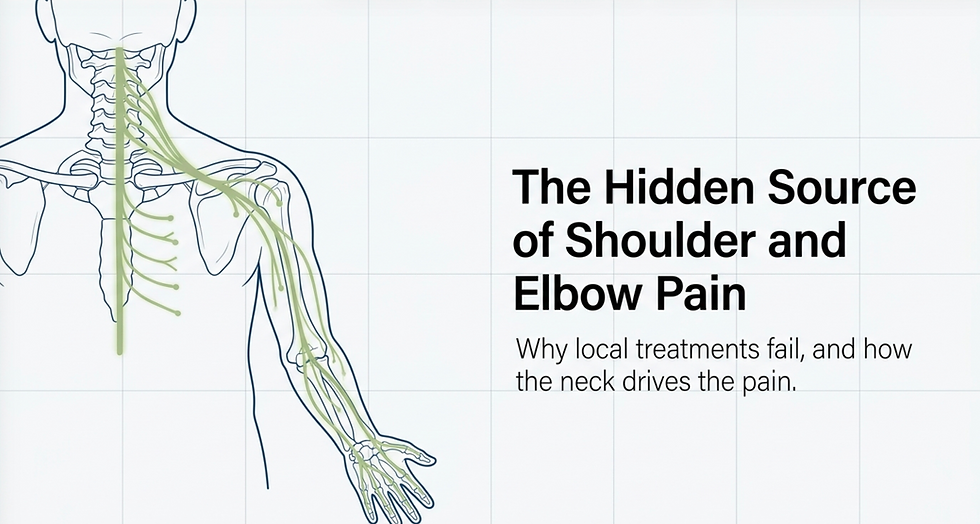
Your cervical spine has nerve roots exiting at each level, C5 through C8, and each one carries sensation from a specific area of your arm and hand. C6 supplies the thumb side of your hand and forearm, C7 the middle finger and back of the forearm, and C8 the pinky side, which is why the exact location of the numbness is genuinely useful diagnostic information rather than just a symptom to note.
These nerve roots exit through small bony openings called neural foramina, and when the facet joints and thoracic spine feeding into them are restricted, the same pattern covered throughout most neck pain conditions, the foramen can narrow slightly and put mild pressure on the nerve root as it exits. On its own, this level of compression is often mild enough that it doesn't reliably produce noticeable numbness, which is part of why imaging can look unremarkable even when a real irritation is present.
This is where a mechanism called the double crush phenomenon matters. A nerve that's already mildly irritated at one point along its path becomes measurably more sensitive to a second, separate point of compression further down its course, even when neither point alone would be enough to cause symptoms. For arm numbness, that second point is usually the scalene muscles in the front of your neck or the pec minor muscle under your collarbone, both of which the nerve roots pass directly through on their way into your arm.
When those muscles are tight, which is common given the same forward head posture and thoracic restriction covered in our other pieces, they add a second, low-level point of compression. Neither the foraminal narrowing nor the muscle tension would necessarily cause numbness by itself. Together, they do.
When the Second Compression Point Gets a Name: Thoracic Outlet Syndrome
The space where the scalene muscles, your first rib, your collarbone, and pectoralis muscles all meet is called the thoracic outlet, and when the structures passing through it get compressed, the result is called thoracic outlet syndrome, or TOS. This is essentially the same second compression point from the double crush mechanism above, given its own clinical name because the thoracic outlet is a genuinely tight space where the brachial plexus nerves, and in some cases the subclavian artery and vein, all pass through together.
Most cases are neurogenic TOS, meaning the brachial plexus nerves are the structures being compressed. This produces the numbness, tingling, and aching pattern already described, often worse with overhead activity, carrying a bag, or prolonged forward head posture, since all three narrow the outlet further. A smaller number of cases are vascular TOS, where the subclavian artery or vein is compressed instead of, or in addition to, the nerves. This produces a distinctly different symptom pattern: a heavy, fatigued, or aching feeling in the arm that builds with activity, along with coldness, paleness or a bluish tint, or visible swelling, depending on whether the artery or the vein is more affected. Vascular TOS is far less common than the neurogenic form but is important to distinguish, since it involves an actual blood vessel rather than a nerve and occasionally requires imaging to rule out clot formation before conservative treatment begins.
Nerve Numbness vs. the "Arm Fell Asleep" Feeling
Patients often describe both the nerve-based numbness above and the common sensation of an arm "falling asleep" the same way, but they're different mechanisms and it's worth being able to tell them apart. When you lean on your arm and it goes numb and tingly for a minute or two after you move it, that's usually a brief, localized compression cutting off blood supply to the nerve itself at a single point, most often the ulnar nerve at the elbow or the radial nerve against the upper arm. The nerve temporarily can't function properly, not because it's damaged, but because its own microscopic blood supply was briefly pinched off. This type of numbness is diffuse, comes on quickly, and resolves within a minute or two once you change position and blood flow returns.
Numbness from a cervical nerve root or thoracic outlet compression behaves differently. It tends to follow a specific strip-like pattern tied to which nerve root or portion of the brachial plexus is involved, it's often triggered or worsened by specific neck or arm positions rather than clearing quickly with any movement, and it can persist for hours or recur predictably throughout the day rather than resolving in a minute. If your numbness clears almost immediately once you shift position, you're most likely dealing with a brief, localized compression like a fallen-asleep limb. If it lingers, follows a consistent pattern, or correlates with your neck position specifically, that points toward the cervical or thoracic outlet mechanisms described above.
When It's Something More Serious
Get evaluated promptly if you notice significant or progressive weakness, numbness affecting both arms at once, loss of coordination or fine motor control, or any change in bladder or bowel function, since these can indicate a more serious form of nerve or spinal cord compression. Left arm numbness accompanied by chest pain, shortness of breath, or sweating should be treated as a possible cardiac event and evaluated immediately, separate from any cervical cause. If your arm becomes noticeably cold, pale or bluish, swollen, or you notice a significant pulse or size difference compared to your other arm, seek evaluation promptly, since this can indicate vascular TOS and may warrant imaging to rule out a blood clot before conservative treatment begins.
How This Gets Addressed
Because this usually involves two points of compression rather than one, resolving it well means addressing both, not just the more obvious one.
Chiropractic care, including cervical and thoracic joint mobilization, opens up foraminal space at the nerve root level, reducing the first point of compression at its source.
Massage therapy targets the second point directly, releasing tension in the scalene and pec minor muscles the nerve passes through further down its path, which is often the piece that finally resolves numbness that neck-only treatment left unchanged.
For scalene or pec minor tension that's become chronic and doesn't fully release with massage, dry needling reaches those specific muscles with more precision.
Two additional pieces support lasting resolution. Physical therapy combines nerve gliding exercises, which help the nerve move more freely through both compression points, with the same postural and deep cervical flexor work covered elsewhere in this series, addressing the load that created both restrictions in the first place.
And because nerve irritability has a systemic component as well as a mechanical one, naturopathic medicine evaluates contributors like B12 status and inflammatory markers through targeted lab testing when numbness persists despite structural improvement.
The brief, fallen-asleep type of numbness is treated differently, largely because it usually doesn't need active treatment at all. A single instance from leaning on your arm resolves on its own once the position changes and normal blood flow returns. If it's happening frequently, though, that's often a sign the thoracic outlet space is chronically narrowed from the same scalene and pec minor tightness described above, which lowers the threshold for even brief positions to cut off circulation, and the same chiropractic, massage, and physical therapy approach that opens that space addresses the underlying reason it keeps happening.
True vascular TOS, marked by persistent color change, swelling, or pulse differences, falls outside conservative care and is referred out for vascular imaging and specialist evaluation before any hands-on treatment begins.
Most patients see meaningful improvement once both compression points, the neck and the muscles further down the nerve's path, are addressed as part of the same plan.
Frequently Asked Questions
How do I know if this is coming from my neck or something like carpal tunnel?
Cervical nerve root numbness tends to follow the strip-like pattern of a specific nerve root and often correlates with neck position or movement. Carpal tunnel numbness is typically confined to the thumb, index, and middle fingers and tends to worsen with wrist position, like driving or holding a phone, rather than neck movement. The two can also coexist, which an evaluation can clarify.
Can neck-related arm numbness happen without any neck pain?
Yes. Because the compression is often mild at each individual point, foraminal narrowing and muscle tension can both be present and producing numbness without significant neck pain, which is part of why this connection gets missed.
When should I actually be concerned about arm numbness?
Occasional, mild numbness tied to posture or activity is common and usually resolves with the right treatment. Sudden onset, progressive weakness, numbness in both arms, or any change in coordination or bladder and bowel function warrant prompt evaluation rather than a wait-and-see approach.


Comments