
Why Does My Vertigo Come and Go for No Reason?


Vertigo that comes and goes without a clear position trigger is often vestibular migraine, in which the same brain circuitry that produces migraine headaches also processes balance signals. Episodes can happen with or without a headache and are frequently set off by poor sleep, dehydration, skipped meals, or hormonal shifts rather than any specific movement.
Being told your scans and hearing tests are normal while the room still tilts for no obvious reason is frustrating, and it does not mean nothing is wrong.
The Mechanism
Migraine is not only a headache disorder. It is a broader pattern of nervous system sensitivity, and the pathways involved run directly through the brainstem structures that process balance. Vestibular migraine happens when that shared circuitry becomes overactive, producing episodes of dizziness or spinning through the same mechanism that produces a migraine headache, whether or not head pain is present at the same time.

The trigger pattern is the key clue that separates this from crystal-related vertigo. Positional vertigo from displaced otoconia (ear stones) is set off reliably by specific head movements, such as rolling over, and resolves within about a minute. Vestibular migraine episodes are unpredictable in comparison. They can last minutes to days, and they respond to the same triggers that provoke migraine headaches: irregular sleep, skipped meals and the blood sugar dips that follow, dehydration, bright or flickering light, strong smells, and hormonal changes across the menstrual cycle. Magnesium and B2 status have also been linked to migraine frequency in research, which is why nutritional status is worth reviewing alongside trigger patterns.
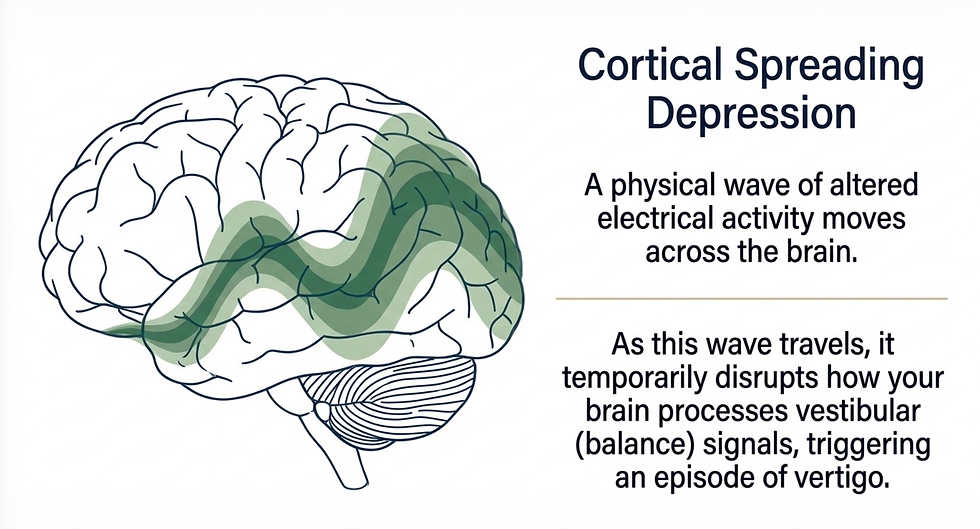
The mechanism itself involves cortical spreading depression, a wave of altered electrical activity that moves across the brain and can temporarily disrupt how vestibular signals are processed, along with heightened sensitivity in the trigeminovascular system, the nerve network that also drives migraine head pain. Because this circuitry overlaps with the same brainstem pathways involved in BPPV recurrence, the two conditions are sometimes confused for each other, and a person can genuinely have both.

When It's Something More Serious
Vertigo that is new, severe, or comes with double vision, slurred speech, trouble swallowing, numbness or weakness, difficulty walking, or a sudden severe headache unlike any before needs emergency care. A first migraine-like episode after age 50, or one that changes character over time, should also be evaluated rather than assumed to be migraine.
How This Gets Addressed
Because vestibular migraine is a sensitivity pattern rather than a structural problem, treatment focuses on lowering the nervous system's overall reactivity and identifying triggers.
Naturopathic medicine reviews sleep, hydration, blood sugar regulation, and nutrient status including magnesium and B2, and builds a trigger-management plan around the pattern that emerges.
Chiropractic care restores motion in the upper cervical spine, since neck tension is a common migraine trigger and adds noise to an already sensitive balance system.
Physical therapy can help when episodes leave lingering unsteadiness between attacks. Any prescription migraine medication should be managed with your physician.
Each part of this plan targets a specific driver of the sensitivity described above. You can learn more about our full approach to vertigo here.
Most patients see their episodes become less frequent and less intense once triggers are identified and the nervous system's baseline reactivity comes down, although migraine-pattern sensitivity tends to be a long-term tendency to manage rather than something that disappears completely.

Written By:
Dr. Jason Winkelmann
Naturopathic doctor, Chiropractor, Chronic Pain Specialist, and Educator
Frequently Asked Questions
Can you have vertigo from migraines without a headache?
Yes. Vestibular migraine can occur with no head pain at all, since the same overactive circuitry that produces migraine headaches can produce isolated episodes of dizziness or spinning. This is one of the more commonly missed causes of unexplained vertigo, since patients and providers alike tend to look for a headache that never comes.
How is vestibular migraine different from BPPV?
BPPV is triggered reliably by specific head positions and each episode resolves within about a minute. Vestibular migraine has a less predictable trigger pattern, tied more to sleep, hydration, food timing, and hormonal shifts, and episodes can last much longer, from minutes to days. The two can coexist, which is why an evaluation considers both possibilities rather than assuming one.
What tests confirm vestibular migraine?
There is no single definitive test. Diagnosis relies on a detailed history of episode pattern, duration, and triggers, along with ruling out inner ear and neurological causes through positional testing and, when warranted, imaging. A personal or family history of migraine headaches supports the diagnosis but is not required for it.


Comments