
Why Does My Neck Pain Come Back a Few Days After a Massage or Adjustment?
- Jason Winkelmann
- 3 days ago
- 4 min read


Neck pain returning within a few days of a massage or adjustment usually means the joint restriction and muscle tension were genuinely released, but the deep stabilizing muscles meant to hold that new position afterward were never retrained to take over the job. Without that retraining, the muscles you just released are still the only support system available, and they rebuild the same tension within days simply because nothing has replaced them.
If you've noticed the same predictable window, three or four good days, then the tightness creeps back right on schedule, that pattern is real and it's telling you something specific about what the treatment addressed and what it didn't.
The Gap Between Releasing Tension and Holding a Correction

A massage or adjustment does real, measurable work. Tight superficial muscles get released, restricted joints regain their normal range of motion, and for a few days you genuinely feel better because that's an accurate reflection of what changed. But release and retraining are two different processes. The deep cervical flexors, the small stabilizing muscles covered in our piece on morning neck stiffness, are what's supposed to hold your neck in that newly corrected position around the clock. A single treatment session releases the muscles that were compensating for the deep stabilizers. It doesn't build the deep stabilizers' capacity to actually take the job back. So the correction holds only until your neck needs sustained support again, usually within a day or two of normal posture and screen use, at which point the same superficial muscles are the only option your body has, and they start compensating all over again.

There's a second layer to why this repeats so predictably. Your nervous system develops a default recruitment pattern, essentially a habit, for which muscles fire first to stabilize your neck, built up over months or years of the deep stabilizers being underused. Releasing tension in a session doesn't change that underlying habit. Your nervous system still defaults to calling on the superficial muscles first, not because the deep stabilizers can't do the job in that moment, but because that recruitment pattern hasn't been practiced enough times to become the new default. Changing which muscle your nervous system reaches for first takes repeated, active retraining, not passive release, which is exactly the piece a single hands-on session isn't built to provide.

When It's Something More Serious
A predictable few-day relief window followed by gradual return of the same familiar tension is typical and not a cause for concern. Get evaluated further, however, if the pain returns faster each time, is progressively worsening rather than cycling at a stable level, doesn't improve even temporarily after treatment, or is accompanied by numbness, weakness, or symptoms spreading into your arm. These patterns suggest something beyond the retraining gap described here.
How This Gets Addressed
Because the recurring cycle comes from a real gap between release and retraining, resolving it means keeping the release work while adding what's been missing.
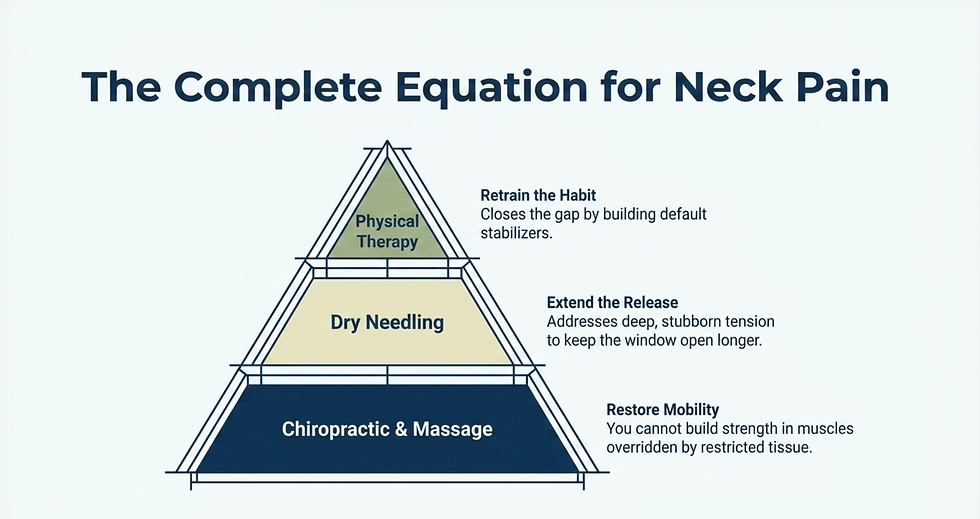
Chiropractic adjustments and massage therapy remain genuinely necessary in this picture, since restoring joint mobility and releasing the compensating muscles is what makes retraining possible in the first place. You can't build strength and control in muscles that are still being overridden by tight, restricted tissue around them.
For deep, stubborn tension in the same compensating muscles, dry needling helps that release hold longer between visits.
The piece that actually closes the gap is physical therapy, specifically a progressive deep cervical flexor strengthening program that gives those muscles the capacity, and gives your nervous system the repeated practice, to become the default stabilizers again instead of relying on the muscles that were just released. This is usually the difference between a treatment plan that produces a repeating few-day cycle and one that produces lasting change.
And when muscles seem resistant to holding a new pattern even with consistent retraining, naturopathic medicine evaluates contributors like magnesium status that affect baseline muscle tone and recovery capacity.
Most patients notice the relief window extending meaningfully once a retraining program is added alongside the manual work, rather than manual work being repeated on its own indefinitely.

Written By:
Dr. Jason Winkelmann
Naturopathic doctor, Chiropractor, Chronic Pain Specialist, and Educator
Frequently Asked Questions
Does this mean the treatment I've been getting isn't working?
No. The relief you're feeling is real and reflects genuine tissue and joint changes. It's incomplete rather than ineffective, because the piece that makes the change last, retraining the muscles that are supposed to hold it, hasn't been part of the plan yet.
How many sessions before the improvement starts to hold longer?
It varies, but many patients notice the relief window extending meaningfully within a few weeks of adding a consistent deep cervical flexor retraining program alongside their existing chiropractic or massage care, since the nervous system needs repeated practice for the new recruitment pattern to become the default.
Is there anything I can do at home between visits to help it hold?
Yes. Specific, guided deep cervical flexor exercises, not general neck stretching, are what actually build the capacity needed to hold a correction between sessions. General stretching mainly affects the same superficial muscles that are already being released in-office and doesn't address the underlying gap.
Comments