
Is Sciatica in Both Legs at Once Something to Worry About?
- Jason Winkelmann
- 15 minutes ago
- 3 min read

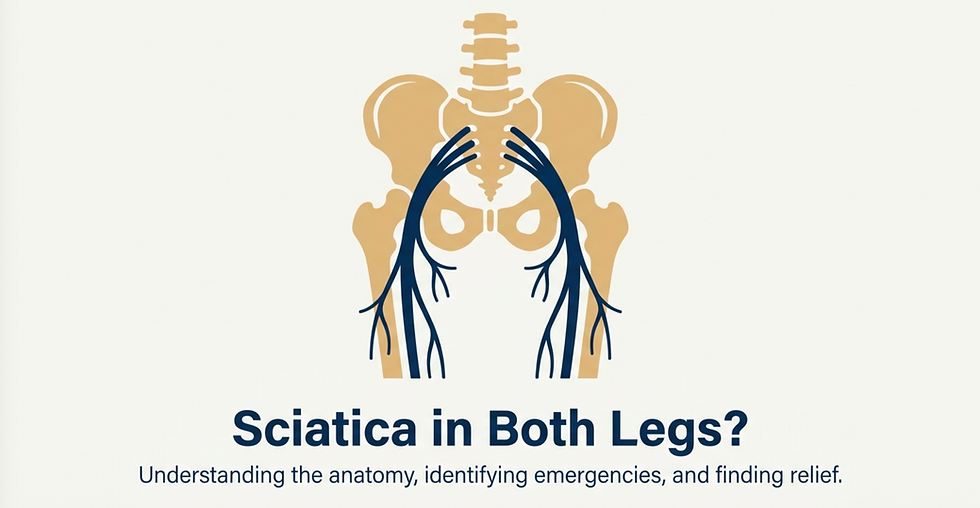
Sciatica in both legs at once is less common than one-sided sciatica and deserves closer attention, since it usually means a more central or broader spinal compression, such as a large central disc herniation or spinal stenosis, rather than the typical single-sided nerve root irritation covered elsewhere in this cluster. Whether it represents a true emergency depends specifically on whether certain additional symptoms are present alongside the bilateral leg pain.
If you're experiencing sciatic symptoms in both legs and understandably feeling more alarmed than you would with one-sided pain, that instinct makes sense, and this piece will walk through exactly how to tell a genuine emergency apart from a more common, manageable cause.
Why Both Sides Points to a Different Kind of Problem
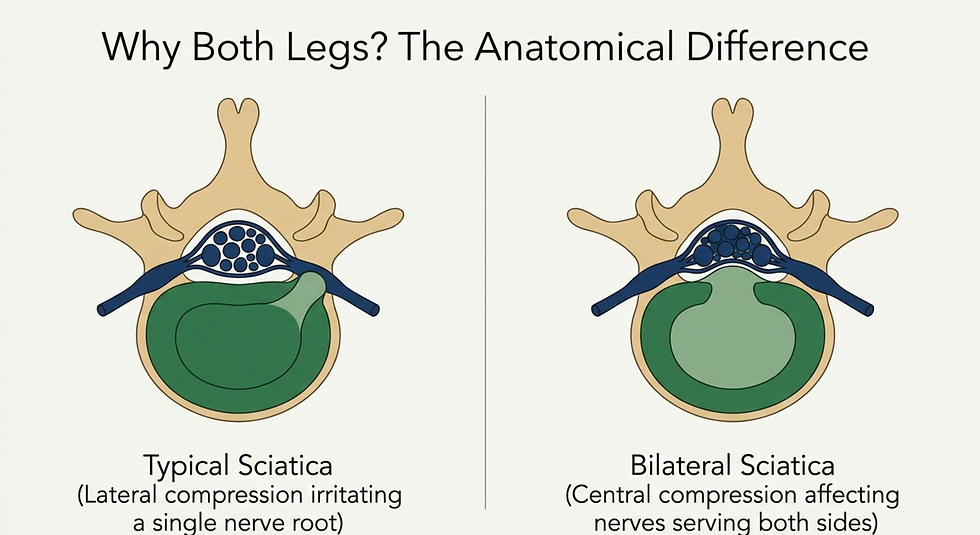
Most sciatica, covered throughout this cluster, comes from a single nerve root or the piriformis muscle being irritated on one side, which is why it's typically felt in one leg. Bilateral symptoms usually mean the compression is happening somewhere more central, either a large disc herniation pushing broadly into the spinal canal rather than laterally toward a single nerve root, or spinal stenosis, a narrowing of the central spinal canal itself, most common in older adults, that can compress nerve structures serving both legs simultaneously.

The critical distinction for how urgently this needs attention comes down to which additional symptoms accompany the bilateral pain. Bilateral leg pain that appears or worsens specifically with walking or standing and eases with sitting or bending forward, a pattern called neurogenic claudication, is a hallmark of spinal stenosis. This is a legitimate condition requiring evaluation and treatment, but it's not itself a medical emergency.

Bilateral leg pain accompanied by loss of bladder or bowel control, numbness in the saddle area, or progressive weakness in both legs is a different situation entirely, and points toward cauda equina syndrome, compression of the bundle of nerve roots at the base of the spinal cord, which is a surgical emergency requiring immediate care.

When It's Something More Serious
Seek emergency care immediately for bilateral leg symptoms accompanied by loss of bladder or bowel control, numbness in the saddle area, or progressively worsening weakness in both legs. If your bilateral symptoms follow the walking-triggered, sitting-relieved pattern of neurogenic claudication without any of those additional signs, prompt evaluation is still warranted, but it is not an emergency requiring immediate emergency room care.
How This Gets Addressed
Once bilateral sciatica has been properly evaluated and the underlying cause identified, treatment is tailored specifically to that cause rather than treated the same as typical one-sided sciatica.
For spinal stenosis, chiropractic care and physical therapy focus on flexion-biased movement and joint mobilization approaches shown to ease nerve compression associated with this specific condition, and naturopathic medicine supports the process through anti-inflammatory contributors evaluated via targeted lab testing.
If bilateral symptoms trace back to symmetric piriformis or SI joint involvement rather than central canal narrowing, using massage therapy and dry needling to address the muscle component directly.
An accurate diagnosis is what determines the right path forward here more than with almost any other question in this cluster, given how differently a benign stenosis pattern and a surgical emergency need to be handled.

Written By:
Dr. Jason Winkelmann
Naturopathic doctor, Chiropractor, Chronic Pain Specialist, and Educator
Frequently Asked Questions
Is bilateral sciatica always an emergency?
No. Bilateral leg pain triggered by walking and relieved by sitting or bending forward is often a sign of spinal stenosis, which needs evaluation and treatment but isn't itself an emergency. Bilateral symptoms combined with loss of bladder or bowel control, saddle numbness, or progressive weakness are the specific combination that requires emergency care.
What is spinal stenosis and how is it different from a herniated disc?
Spinal stenosis is a narrowing of the central spinal canal, most often from age-related degenerative changes, that can compress nerve structures on both sides at once. A herniated disc is a specific disc pushing outward, most often affecting one side, though a large central herniation can occasionally cause bilateral symptoms as well.
Should I go to the emergency room or schedule a regular appointment?
Go to the emergency room immediately for any loss of bladder or bowel control, saddle numbness, or progressive bilateral weakness. For bilateral leg pain without those specific symptoms, particularly if it follows a walking-triggered, sitting-relieved pattern, a prompt regular evaluation is appropriate rather than an emergency room visit.


Comments