
Is Gluten Quietly Driving Your Chronic Pain? (Even If Your Tests Are Normal)

Updated: Aug 21

TL;DR
Gluten is rarely the root cause of chronic pain, but it is often a major contributor that gets completely overlooked. In many chronic pain patients, it disrupts gut integrity, chronically activates the immune system, and increases nervous system sensitivity. What feels like a harmless part of your diet may actually be one of the inputs keeping your system inflamed, reactive, and stuck in a pain cycle. Even if your tests come back normal.
What Patients Are Usually Told
Most patients are told that gluten is only a problem if you have celiac disease. If your blood work is negative, the assumption is that gluten is not affecting you in any meaningful way.
On the surface, that explanation sounds logical. Celiac disease is well-defined, and testing for it is widely available, so it gives both patients and providers a clear framework.
The problem is that this framework is far too narrow.
What many patients are never told is that celiac disease is just one very specific manifestation of how gluten can interact with the body. It is not the only way, and in chronic pain patients, it is often not even the most relevant way.
Where That Explanation Breaks Down
The issue is not that gluten only affects one system. The issue is that it affects several systems at the same time. It influences the gut, the immune system, and the nervous system simultaneously. When those systems are already under stress, which is true for essentially every chronic pain patient, gluten does not act as a neutral input. It acts as a multiplier.
So when someone says, “Your test is normal,” what they are really saying is that a very small piece of a much larger physiological picture was evaluated.
Symptoms Are Signals, Not the Problem
Before going further, we need to clarify something that changes how all of this is interpreted.
Pain is not the problem. It is a symptom.
This is one of the most important concepts in chronic pain, and it is also one of the most misunderstood. As long as pain is treated as the issue itself, the systems producing that pain are left unaddressed. And when that happens, symptoms persist, even if they are temporarily suppressed.
So instead of asking whether gluten is “causing” your pain, a more accurate question is whether it is contributing to the systems that are generating that signal.
The Physiology Most Patients Are Never Taught
Under normal conditions, your small intestine is designed to be both highly selective and highly efficient. It is lined by a single layer of cells that are tightly packed together, forming a barrier that allows fully digested nutrients to pass through while keeping harmful substances out.
This barrier is regulated by structures called tight junctions, which open and close in a controlled manner based on the body’s needs. This is what allows digestion and protection to happen at the same time.
The problem begins when that regulation is disrupted.
Gluten interacts with the gut in a very specific way. It activates a signaling molecule called zonulin, which causes those tight junctions to open. In a healthy system, that opening is temporary. The junctions open, serve their purpose, and then close again.
But in many individuals, especially those already dealing with chronic illness, those junctions do not close the way they should. Now the barrier is no longer functioning as intended.
This is called intestinal permeability, or leaky gut.

How This Change Creates Systemic Stress
Once those tight junctions remain open longer than they should, the rules of what can enter the bloodstream begin to change.
Food no longer has to be fully broken down into its smallest components to pass through the gut lining. Larger, partially digested particles can now enter circulation. At the same time, bacteria and other unwanted substances that would normally be contained are able to cross that barrier as well.
The immune system is designed to respond to exactly this kind of situation. It recognizes these particles as threats and activates to neutralize them.
That response is appropriate, initially. But when this process is happening repeatedly, meal after meal, day after day, the immune system is no longer responding to an occasional issue. It is being activated continuously. And every time it activates, it produces inflammation.
This is actually how most autoimmune conditions begin, why so many chronic pain conditions are autoimmune in nature, and why many autoimmune conditions accompany chronic pain conditions.

From Immune Activation to Chronic Pain
Inflammation is not inherently a problem. It is part of the body’s healing response. The issue arises when it becomes chronic.
When the immune system is constantly activated, inflammation becomes a baseline state rather than a temporary response. This begins to affect tissues that were never the original target, including the nervous system.
Over time, this leads to increased nerve sensitivity. Pain signals become easier to trigger, more intense when they occur, and slower to resolve. What started as a gut-level issue has now translated into a nervous system-level problem.
This is where many chronic pain patients live, even though they were never told how they got there.
The Other Autoimmune Piece Most Patients Miss
There is another layer to this that is rarely explained.
On a microscopic level, some proteins look awfully similar to others. Specifically, gluten shares a resemblance with certain human tissues, such as thyroid and nervous system tissue. This is known as molecular mimicry, and in cases of excess immune system activation, your immune system can lose track of the actual threat and start attacking you instead.
In some individuals with gluten sensitivity, their immune system begins attacking their nervous system. Nerve damage creates pain, numbness, tingling, loss of sensation, and inflammation. Which creates more pain and perpetuates the cycle.

The Gut–Brain Connection and Why Pain Amplifies
At this point, the nervous system is already under stress, but there is another mechanism that amplifies the problem even further.
Your gut contains an extensive network of neurons known as the enteric nervous system. This system communicates directly with the brain through the vagus nerve. Under normal conditions, this communication is balanced and regulated.
But when the gut is under constant stress, it sends continuous signals to the brain indicating that something is wrong. The brain responds by increasing vigilance.
At the level of the spinal cord, there is normally a filtering system that limits how much information reaches the brain. But under sustained stress, that filter becomes less effective.
More signals get through, including signals that would normally be ignored. This is what is referred to as central sensitization.
Now the system is no longer just reacting to real threats. It is overreacting to minor inputs, amplifying pain in the process.
The Missing Piece: Absorption and Recovery
There is another consequence of this process that patients often feel but rarely understand.
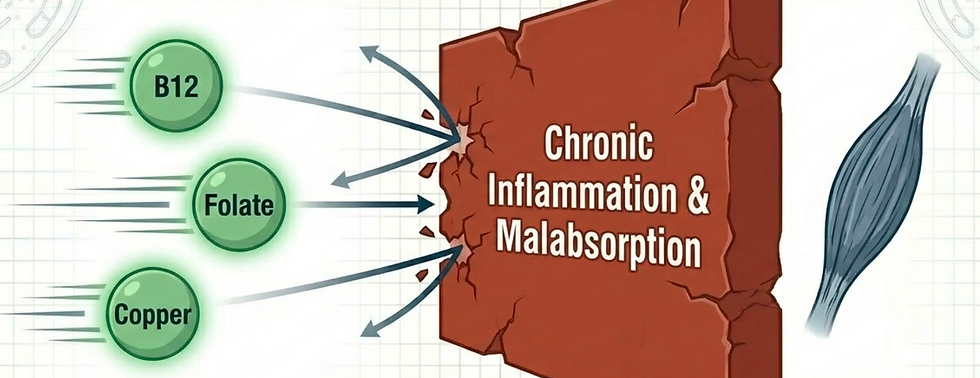
When the gut lining is compromised, nutrient absorption is also affected. Even if your diet appears adequate, your body may not be able to access what it needs.
Nutrients like vitamin B12, folate, and copper are essential for nerve function, circulation, and tissue recovery. Gluten directly and indirectly decreases the absorption of these nutrients.
When absorption is impaired, the body loses its ability to repair itself effectively. This shows up as persistent tightness, weakness, fatigue, and delayed recovery. Symptoms that are often blamed on overuse or aging, but are actually rooted in your gut health.
Why Your Tests Are "Normal" Even Though You Have A Gluten Sensitivity
Testing for celiac disease is a straightforward process. Testing for a gluten sensitivity is completely different.
Most tests either test wheat directly or test for alpha-gliadin sensitivity.
Wheat as a whole looks very different, on a microscopic level, than the individual proteins that make up gluten. In a laboratory setting, your immune system might not react to wheat. But in a real-world scenario, when you digest wheat you break it up into its individual proteins. Your immune system reacts to these individual proteins.
Alpha-gliadin is one of those proteins. But it is just one. There are actually four different gliadin subtypes, as well as glutenin, and wheat germ agglutinin. Your immune system can react to any of these proteins, but if you do not test for them all specifically, your test may come back negative despite being sensitive to gluten.
Why Treatments Often Fall Short
At this point, it becomes easier to understand why so many treatments fail.
Most approaches to chronic pain focus on reducing the symptoms. They attempt to decrease inflammation, relax muscles, or block pain signals. While these strategies can provide temporary relief, they do not address the systems driving the problem.
Chronic pain is not a single-system issue. It is always the result of interacting physical, biochemical, and nervous system factors.
If you only address one of those, the others continue to reinforce the cycle. This is why patients often feel like they have “tried everything” but are still stuck.

Gluten Is Not the Cause—But It Is a Major Contributor
It is important to be precise here.
Gluten is not the root cause of chronic pain.
But in a system that is already inflamed, sensitive, and dysregulated, it becomes a consistent input that keeps activating the very processes driving that pain.
A helpful way to think about it is this: Gluten is not the fire. But it is very often the fuel.

Written By:
Dr. Jason Winkelmann
Naturopathic doctor, Chiropractor, Chronic Pain Specialist, and Educator
Frequently Asked Questions
If my celiac test is negative, can gluten still be affecting my body?
Yes. Celiac disease is only one specific immune reaction to gluten. What many patients are never told is that gluten can still disrupt gut barrier function, activate the immune system, and influence the nervous system even without meeting the criteria for celiac disease. What this means for patients is that a “normal” test does not rule out gluten as a contributor to inflammation, nerve sensitivity, or chronic pain—it simply rules out one narrow condition.
How would gluten contribute to chronic pain if it’s a gut issue?
Under normal conditions, the gut acts as a controlled barrier. When gluten increases intestinal permeability, that barrier becomes less selective, allowing immune activation to occur more frequently. Over time, this leads to chronic inflammation, which directly affects the nervous system by increasing sensitivity. In simpler terms, what starts in the gut does not stay in the gut—it can amplify how easily your body produces pain signals.
Why do my symptoms feel neurological (tingling, burning, sensitivity) instead of digestive?
This is where the explanation most patients receive becomes incomplete. Gluten-related immune activation does not only affect digestion—it can also impact nerve tissue through inflammation and molecular mimicry. When the immune system is repeatedly activated, it can begin to affect the nervous system itself. What this means for patients is that symptoms like tingling, burning, or hypersensitivity can develop even without obvious digestive issues.
If gluten is contributing, why haven’t treatments helped me?
Most treatments focus on suppressing symptoms rather than identifying what is driving them. As outlined in the True Health clinical model, chronic pain is always influenced by physical, biochemical, and nervous system factors working together . If gluten is consistently triggering immune activation and inflammation, it can keep those systems in a stressed state. What this means is that even effective treatments may feel temporary because an ongoing input is continuing to reinforce the cycle.


Comments