
Magnesium for Chronic Pain: Does It Actually Help – or Is It Overhyped?

Updated: Aug 21
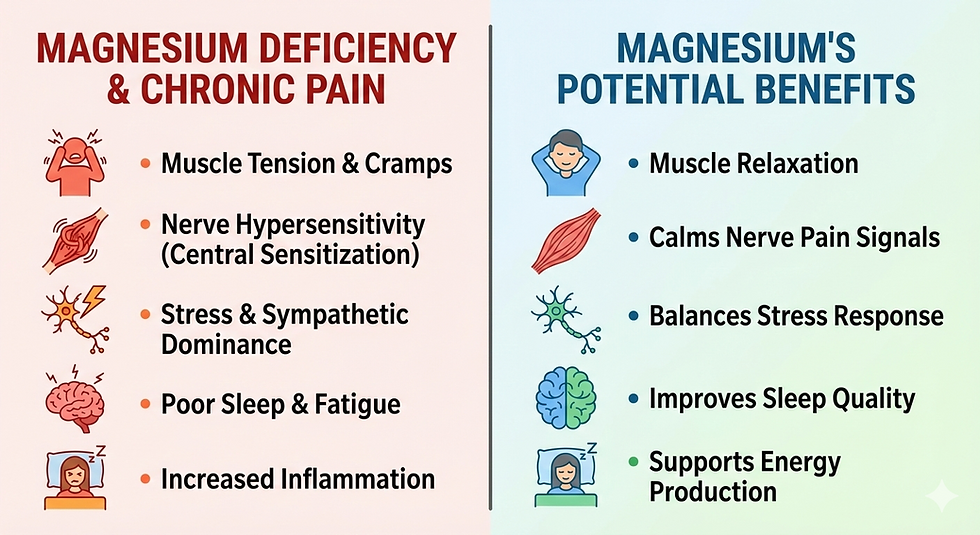
TL;DR
Magnesium can help some people with chronic pain, but it is not a universal solution; and whether it helps depends on why you are in pain. Magnesium plays a critical role in nerve signaling, muscle relaxation, mitochondrial energy production, and regulation of NMDA pain receptors involved in central sensitization. In people with migraine, fibromyalgia, muscle tension, or stress-driven pain amplification, low or poorly utilized magnesium may contribute to heightened nervous system reactivity. However, simply supplementing magnesium does not correct the broader nervous system, immune, and metabolic patterns that sustain chronic pain.
Magnesium may be supportive, but it works best when understood as part of a larger systems-based picture, not as a standalone fix.
If you live with chronic pain, you’ve probably heard some version of this advice:
“Try magnesium.”
But almost no one explains why.
Is it for muscle tightness? Energy? Sleep? Inflammation? Nerve pain? Stress?
Magnesium is often recommended casually, as if it were a general wellness vitamin. In reality, it is one of the most physiologically relevant minerals in chronic pain, and one of the most commonly underdosed or poorly absorbed.
This article will walk through the real mechanisms.
Not folklore. Not supplement marketing. Not vague “it supports over 300 reactions” statements.
Just physiology.
How Does Magnesium Help Chronic Pain?
Chronic pain is rarely just one thing. It typically involves:
Magnesium sits at the intersection of all of these systems.
Let’s break that down.
Is Magnesium Really a Natural Muscle Relaxer?
Yes, but not in the way most people understand.
Muscle contractions begin with calcium. When calcium binds to a receptor called calmodulin, located inside muscle fibers, a biochemical and physical cascade of events occurs that results in a muscle contraction. That contraction persists as long as calcium remains bound.
Magnesium’s role is to displace calcium.
When magnesium binds to calmodulin, calcium releases, and the muscle relaxes.
If magnesium levels are insufficient, calcium signaling becomes dominant. The result is persistent low-level contraction. Not a full cramp. Not paralysis. But chronic, guarded tightness.
Patients describe this as:
“My muscles never turn off.”
“I wake up tight.”
“Massage helps, but it comes right back.”
“It feels like I just worked out all the time.”
This is common in fibromyalgia, chronic neck and shoulder pain, tension headaches, and persistent low back pain.
Magnesium does not “sedate” muscles. It restores balance to calcium signaling.
Does Magnesium Help With Nerve Pain?
This is where magnesium becomes more interesting.
In the brain and spinal cord, pain transmission is amplified by a receptor called the NMDA receptor.
This receptor:
Activates in response to glutamate (an excitatory neurotransmitter common in disc herniations and central sensitization)
Allows calcium to enter neurons which causes nerves to fire
Amplifies pain signals
Contributes to central sensitization
Central sensitization is what makes:
Light touch feel painful
Old injuries flare unpredictably
Pain persist after tissue healing
Stress worsen symptoms
Magnesium naturally blocks the NMDA receptor channel.
Even when the receptor is activated, magnesium sits in the pore and limits calcium influx.
This mechanism is quite powerful. Ketamine, used in severe chronic pain syndromes like CRPS, also works by blocking NMDA receptors.
That does not mean magnesium equals ketamine. But it does mean magnesium directly influences one of the most potent pain-amplifying pathways in the nervous system.
Additionally, magnesium helps regulate glutamate levels. Excess glutamate increases excitatory signaling and pain sensitivity. Magnesium helps keep that in check.
If you have hyper-sensitive nerves, magnesium is not optional physiology.
Can Magnesium Improve Energy and Fatigue in Chronic Pain?
Yes, but not because it “gives energy.”
Magnesium stabilizes and helps transport ATP throughout your body.
ATP is your cellular energy molecule. But ATP is unstable on its own. In the body, it functions as Mg-ATP (magnesium-bound ATP.)
Without magnesium:
ATP stability decreases
Energy transport becomes inefficient
Tissue repair slows
Many chronic pain patients describe:
Delayed recovery
Post-exertional pain and fatigue worsening
Mitochondrial efficiency matters in these patterns. Magnesium does not stimulate energy. It stabilizes it.
Does Magnesium Reduce Inflammation?
Indirectly and directly.
Magnesium deficiency is associated with:
Elevated CRP (an inflammation marker)
Increased pro-inflammatory cytokines
Heightened oxidative stress (from free radicals)
Magnesium also supports conversion of plant-based omega-3 fatty acids (ALA) into anti-inflammatory EPA and DHA. If someone consumes plant omega-3s but lacks magnesium, conversion becomes even less efficient.
Magnesium also modulates immune cell activation and calcium-dependent inflammatory cascades.
Inflammation in chronic pain is rarely acute and dramatic. It is low-grade and persistent. Magnesium helps regulate that baseline tone.
Why Does Stress Make Chronic Pain Worse – And Where Does Magnesium Fit?
Stress physiology depletes magnesium.
Cortisol and adrenaline increase urinary magnesium excretion. Chronic stress, chronic sympathetic activation, and sleep deprivation all contribute to magnesium depletion.
At the same time:
Low magnesium increases your sympathetic nervous system (fight or flight)
Increases muscle tension
Worsens sleep
Amplifies NMDA activity
This creates a loop: Stress → magnesium depletion → increased nervous system reactivity → worse pain → more stress.
Magnesium supports parasympathetic tone (rest and digest) and GABA (calming neurotransmitter) signaling. It does not sedate you, it stabilizes excitability.
Does Magnesium Help Sleep in Chronic Pain?
Indirectly, magnesium:
Supports GABA receptor function
Modulates melatonin regulation
Reduces sympathetic nervous system overactivation
Chronic pain patients often experience non-restorative sleep. That is rarely just “insomnia.” It is nervous system hypervigilance.
Magnesium reduces excitatory neurotransmitter signaling, allowing deeper sleep cycles.
Better sleep improves:
Pain threshold
Tissue repair
Hormonal regulation
Emotional resilience
Magnesium is foundational in that cascade.
Why Have I Tried Magnesium and Not Noticed a Difference?
This is the most important question.
There are five common reasons magnesium appears to “fail”:
1. Wrong Form
Magnesium is an unstable ion. It needs to be bound to something in order to be absorbed and used throughout the body. There are many different forms of magnesium that claim to do different things. You have probably seen this chart before, and been told that the complementary molecule shuttles magnesium to specific body parts to do specific things.

This is misleading because, in reality, it is not the magnesium that is doing that action, it is molecule that is bound to magnesium that is facilitating that result. In the case of chronic pain, we want magnesium, and as much of it as possible. Therefore, we look to the most absorbable and bioavailable forms: magnesium glycinate or citrate (great if you experience regular constipation)
2. Dose Too Low
The recommended daily allowance for magnesium is set at 310-320mg/day for women and 400-420mg/day for men. The RDA is designed to prevent acute deficiency and keep you alive, not help you heal from something like chronic pain. And when some estimates suggest that 80% of Americans are magnesium deficient, that number is much too low.
3. No Loading Phase
Magnesium is one of the most utilized minerals in the body. When you consume magnesium it will always go towards supporting your life saving organs first, and if there is any left over then it goes to places like your muscles. In order to feel the desired effects of magnesium, we need to make sure that everything else in your body is satisfied first.
To accomplish this, we typically start with a loading dose that is much higher than your every day does will be. This requires constantly momitoring and adjusting your dose until you hit your upper limit. This is typically recognized by bowel tolerance. If your magnesium causes loose stools, then you are no longer absorbing more of it and this is your upper limit. Dose just below the threshold of bowel tolerance for a couple of weeks to months and then start slowly reducing your daily dose until you find a dose that maintains your desired effect.
4. Gut Absorption Issues
Low stomach acid, bile insufficiency, IBS, or chronic inflammation can impair mineral absorption. In these instances, you will not absorb as much magnesium as you are ingesting.
5. Ongoing Depletion
Certain medications increase magnesium loss:
Proton pump inhibitors
Diuretics
Some antibiotics
Chronic high-dose vitamin D without balance
If depletion exceeds intake, supplementation may appear ineffective.
How Much Magnesium Should You Take for Chronic Pain?
There is no universal dose. A practical clinical approach is titration:
Start with one capsule daily
Increase weekly if no benefit
Continue until improvement
Loose stools indicate you've exceeded absorption capacity
Back down slightly
This creates a personal therapeutic ceiling. After a loading phase, a maintenance dose can often be lower.
Magnesium is not a one-time fix. It is a mineral that supports ongoing regulation.
Is Magnesium Safe?
For most individuals with normal kidney function, magnesium is safe when titrated appropriately.
Excess magnesium in healthy individuals is typically eliminated via stool. However, anyone with kidney impairment should consult a physician before high-dose supplementation.
Is Magnesium a Cure for Chronic Pain?
No. But chronic pain is rarely caused by a single variable anyways.
Magnesium influences:
Muscle contraction
ATP stability
NMDA receptor activity
Glutamate regulation
Inflammatory tone
Stress physiology
Sleep quality
Autonomic balance
All things that contribute to chronic pain. Few nutrients touch that many relevant systems. If chronic pain is a systems problem, and it is, magnesium is foundational physiology.
The Clinical Takeaway
Magnesium is not glamorous. It is not patented. It is not heavily marketed in pain medicine.
But it directly and indirectly influences the mechanisms that keep chronic pain amplified.
When patients tell me: “I feel tight all the time.”“My nerves are hypersensitive.”“I’m exhausted but wired.”“I don’t recover well.” I automatically ask them about their magnesium intake through foods and supplementation
Magnesium is rarely the only answer. But it is often a missing one.
And when foundational physiology is missing, nothing layered on top works as well as it should.

Written By:
Dr. Jason Winkelmann
Chronic Pain Specialist and Educator
Frequently Asked Questions
How does magnesium affect chronic pain physiologically?
Magnesium influences pain primarily through its regulation of the NMDA receptor, one of the main excitatory glutamate receptors in the central nervous system. When magnesium levels are adequate, they help block excessive NMDA activation. When magnesium is low or functionally depleted, NMDA signaling increases, contributing to heightened pain sensitivity and central sensitization.
Magnesium also:
Regulates muscle contraction and relaxation
Supports mitochondrial ATP production (cellular energy)
Modulates inflammatory cytokine signaling
Stabilizes autonomic nervous system activity
Supports sleep architecture
In chronic pain conditions—where we often see sympathetic dominance, sleep disruption, mitochondrial inefficiency, and increased glutamatergic signaling—magnesium becomes clinically relevant because it interfaces with all of these systems simultaneously.
Is magnesium helpful for specific conditions like migraine or fibromyalgia?
There is evidence supporting magnesium’s role in migraine prevention, particularly in individuals with low intracellular magnesium. Studies have shown that magnesium supplementation can reduce migraine frequency and intensity in certain populations.
In fibromyalgia and other centralized pain conditions, magnesium may help reduce muscle tenderness, improve sleep quality, and decrease nervous system reactivity—especially when symptoms include widespread tightness, fatigue, and stress sensitivity.
However, magnesium is not a standalone treatment. Chronic pain conditions are multi-system disorders involving immune signaling, autonomic regulation, endocrine function, and central processing. Magnesium may reduce one layer of excitability, but it does not address all drivers of persistent pain.
Can you have normal lab results and still benefit from magnesium?
Yes.
Standard serum magnesium testing measures only about 1% of total body magnesium. Most magnesium is intracellular—inside muscle cells, bone, and nervous tissue. Serum levels can appear “normal” even when intracellular magnesium is suboptimal.
Clinically, we often consider magnesium status in patients who experience:
Muscle tightness or cramping
Stress intolerance
Poor sleep
Headaches
Constipation
High sympathetic nervous system tone
In chronic pain patients, normal labs do not always reflect functional physiology. This is a common theme across many systems—not just magnesium.
What type of magnesium is best for chronic pain?
The most absorbable and bioavailable forms of magnesium are best for chronic pain. These include magnesium glycinate and citrate.
We always advise avoiding magnesium oxide as this is a diuretic and gets urinated out easily.


Comments